
Sensex, Nifty drop most in 10 months; India VIX index jumps 23%
Topics
Sensex | Nifty | Global stocks
Samie Modak |
Last Updated at February 15, 2022 02:12 IST
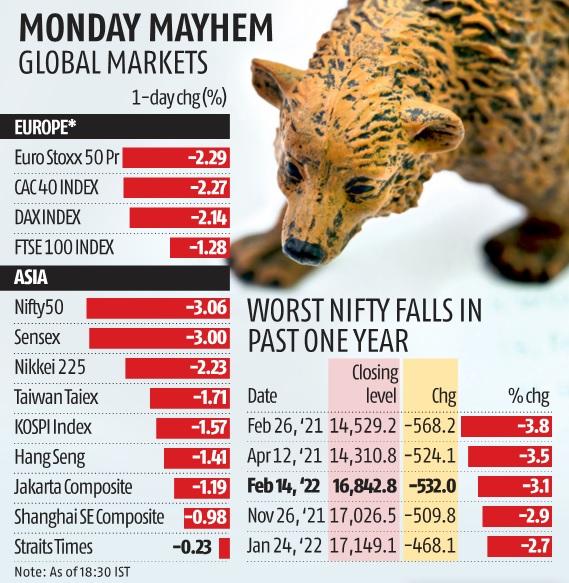
Global stocks were caught in the crosshairs of Russia-Ukraine tensions on Monday, with India’s benchmark indices falling more than 3 per cent as the threat of an imminent war prompted investors to flee risky assets.
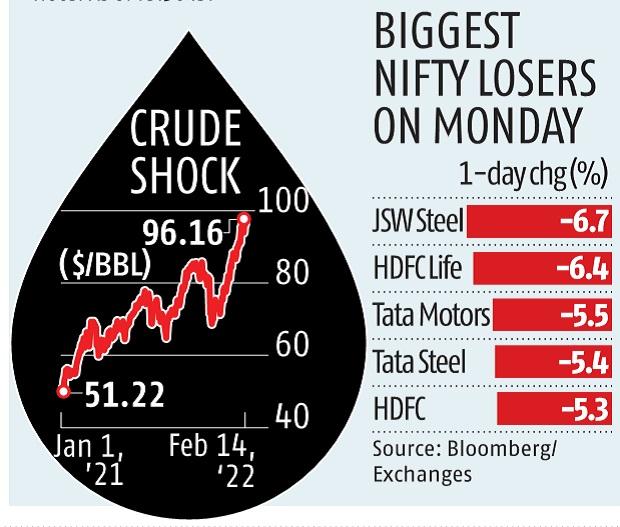
Brent crude prices rose past $96 a barrel, the highest level in more than seven years, stoking concerns that they will dent corporate profitability and worsen the macroeconomic situation. Other commodities also rallied on fears of US sanctions against Russia, sparking worries about further acceleration in inflation. The call by a US Federal Reserve official for raising interest rates by a full percentage point also provided more ammunition to bears.
The Sensex dropped 1,747 points, or 3 per cent, to finish at 56,406, the lowest since December 21, 2021. The Nifty50 index fell 532 points, or 3.1 per cent, to close at 16,843, with all but one of its indices ending with losses.
This was the biggest single-day fall for both the indices since April 12, 2021, and the third biggest in the past one year. The market breadth was firmly in the red as more than 3,000 stocks fell and only 550 advanced on the BSE.
The rupee depreciated 0.29 per cent, or 22 paise, against the dollar. After touching an intra-day low of 75.64, the rupee closed the day at 75.60 a dollar, as against the previous close of 75.38. The India VIX index jumped 23 per cent, signalling investor anxiety.
Until last week, the situation on the Russia-Ukraine border wasn’t perceived as a big threat by the financial market. However, a warning by the US that an attack could be imminent sent shockwaves across the markets. US President Joe Biden told his Ukrainian counterpart Volodymyr Zelensky on Sunday that Washington would respond to Russian military action “swiftly and aggressively”. Russia, however, has repeatedly denied its plans to invade its neighbour.
“The element of uncertainty is very high. If the Ukraine crisis aggravates into a conflict, it can inflict damage to the market in the short run,” said V K Vijayakumar, chief investment strategist at Geojit Financial Services.
Economists warned that US sanctions on Russia would have a severe impact on food, energy and metal prices. International oil prices have already jumped more than 20 per cent this year.
“Geopolitical tension and the rising crude prices are weighing on investors’ sentiments, leading to a sharp rise in volatility. Last week, US bond yields hit 2 per cent in response to the multi-decade high inflation, indicating the possibility of further rate hike projection by the US Fed. All the macro-economic developments are leading to volatility in major asset classes including equity, debt, and currency,” said Naveen Kulkarni, chief investment officer, Axis Securities.
Overseas investors sold shares worth Rs 4,254 crore, while domestic investors provided buying support to the tune of Rs 2,170 crore.
The Nifty Smallcap 100 and Midcap 100 index crashed about 4 per cent each on Monday.
Among individual stocks, Tata Steel, HDFC, and SBI dropped over 5 per cent each. TCS, which is set to commence its Rs 18,000-crore buyback, was the only gaining stock on the Sensex and the Nifty.
All sectoral gauges ended with losses. Realty and metal indices fell over 5 per cent each, while the Bank Nifty index declined 4.2 per cent.
 Dear Reader,
Business Standard has always strived hard to provide up-to-date information and commentary on developments that are of interest to you and have wider political and economic implications for the country and the world. Your encouragement and constant feedback on how to improve our offering have only made our resolve and commitment to these ideals stronger. Even during these difficult times arising out of Covid-19, we continue to remain committed to keeping you informed and updated with credible news, authoritative views and incisive commentary on topical issues of relevance.
We, however, have a request.
As we battle the economic impact of the pandemic, we need your support even more, so that we can continue to offer you more quality content. Our subscription model has seen an encouraging response from many of you, who have subscribed to our online content. More subscription to our online content can only help us achieve the goals of offering you even better and more relevant content. We believe in free, fair and credible journalism. Your support through more subscriptions can help us practise the journalism to which we are committed.
Support quality journalism and subscribe to Business Standard.
Digital Editor
Sensex, Nifty drop most in 10 months; India VIX index jumps 23% Topics Sensex | Nifty | Global stocks Samie Modak | Mumbai Last Updated at February 15, 2022 02:12 IST Global stocks were caught in the crosshairs of Russia-Ukraine tensions on Monday, with India’s benchmark indices falling more than 3 per cent as the threat of an imminent war prompted investors to flee risky assets. Brent crude prices rose past $96 a barrel, the highest level in more than seven years, stoking concerns that they will dent corporate profitability and worsen the macroeconomic situation. Other commodities also rallied on fears of US sanctions against Russia, sparking worries about further acceleration in inflation. The call by a US Federal Reserve official for raising interest rates by a full percentage point also provided more ammunition to bears. The Sensex dropped 1,747 points, or 3 per cent, to finish at 56,406, the lowest since December 21, 2021. The Nifty50 index fell 532 points, or 3.1 per cent, to close at 16,843, with all but one of its indices ending with losses. This was the biggest single-day fall for both the indices since April 12, 2021, and the third biggest in the past one year. The market breadth was firmly in the red as more than 3,000 stocks fell and only 550 advanced on the BSE. The rupee depreciated 0.29 per cent, or 22 paise, against the dollar. After touching an intra-day low of 75.64, the rupee closed the day at 75.60 a dollar, as against the previous close of 75.38. The India VIX index jumped 23 per cent, signalling investor anxiety. Until last week, the situation on the Russia-Ukraine border wasn’t perceived as a big threat by the financial market. However, a warning by the US that an attack could be imminent sent shockwaves across the markets. US President Joe Biden told his Ukrainian counterpart Volodymyr Zelensky on Sunday that Washington would respond to Russian military action “swiftly and aggressively”. Russia, however, has repeatedly denied its plans to invade its neighbour. “The element of uncertainty is very high. If the Ukraine crisis aggravates into a conflict, it can inflict damage to the market in the short run,” said V K Vijayakumar, chief investment strategist at Geojit Financial Services. Economists warned that US sanctions on Russia would have a severe impact on food, energy and metal prices. International oil prices have already jumped more than 20 per cent this year. “Geopolitical tension and the rising crude prices are weighing on investors’ sentiments, leading to a sharp rise in volatility. Last week, US bond yields hit 2 per cent in response to the multi-decade high inflation, indicating the possibility of further rate hike projection by the US Fed. All the macro-economic developments are leading to volatility in major asset classes including equity, debt, and currency,” said Naveen Kulkarni, chief investment officer, Axis Securities. Overseas investors sold shares worth Rs 4,254 crore, while domestic investors provided buying support to the tune of Rs 2,170 crore. The Nifty Smallcap 100 and Midcap 100 index crashed about 4 per cent each on Monday. Among individual stocks, Tata Steel, HDFC, and SBI dropped over 5 per cent each. TCS, which is set to commence its Rs 18,000-crore buyback, was the only gaining stock on the Sensex and the Nifty. All sectoral gauges ended with losses. Realty and metal indices fell over 5 per cent each, while the Bank Nifty index declined 4.2 per cent. Dear Reader, Business Standard has always strived hard to provide up-to-date information and commentary on developments that are of interest to you and have wider political and economic implications for the country and the world. Your encouragement and constant feedback on how to improve our offering have only made our resolve and commitment to these ideals stronger. Even during these difficult times arising out of Covid-19, we continue to remain committed to keeping you informed and updated with credible news, authoritative views and incisive commentary on topical issues of relevance. We, however, have a request. As we battle the economic impact of the pandemic, we need your support even more, so that we can continue to offer you more quality content. Our subscription model has seen an encouraging response from many of you, who have subscribed to our online content. More subscription to our online content can only help us achieve the goals of offering you even better and more relevant content. We believe in free, fair and credible journalism. Your support through more subscriptions can help us practise the journalism to which we are committed. Support quality journalism and subscribe to Business Standard. Digital Editor