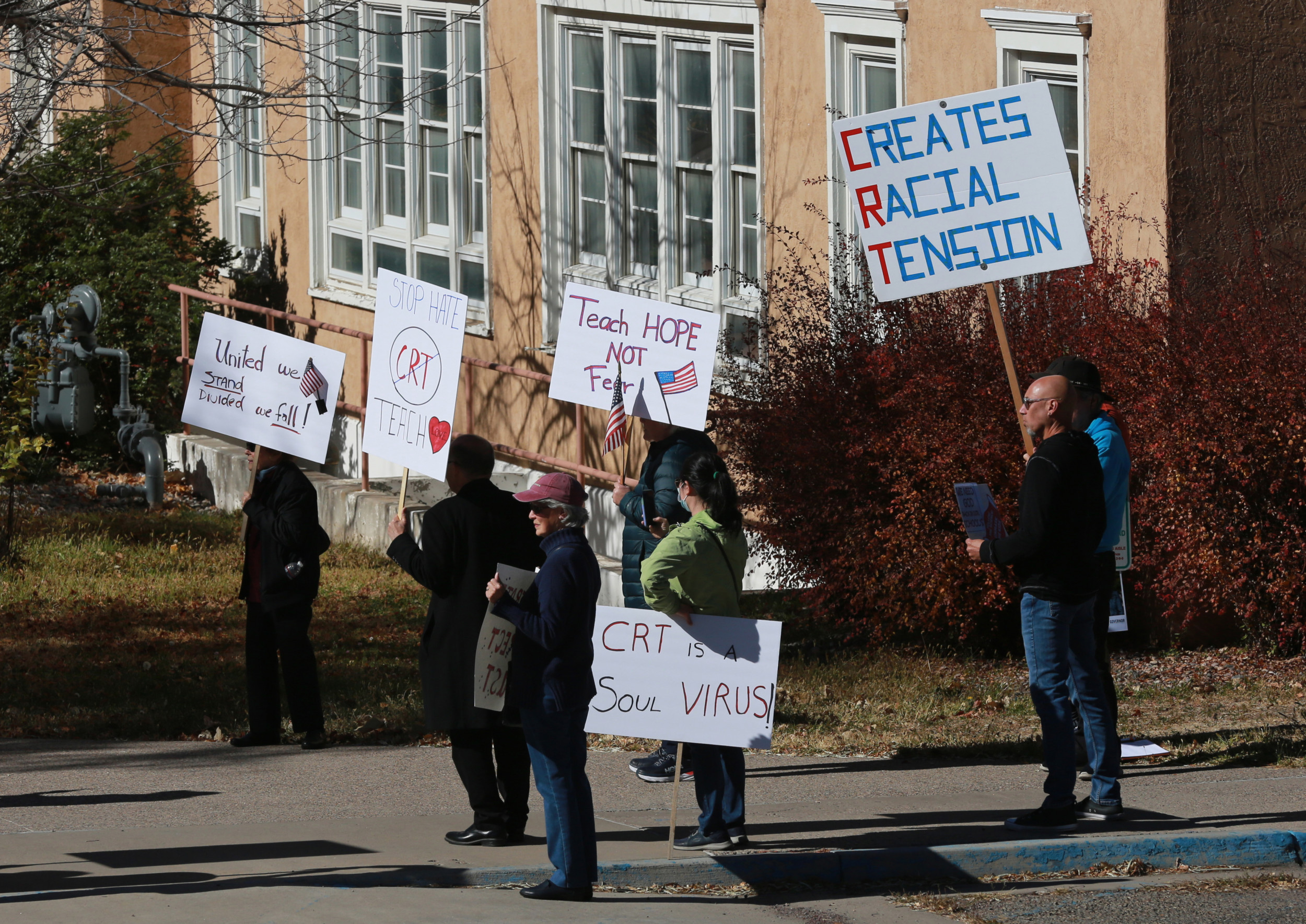
As the debate over Critical Race Theory (CRT) rages on, a recent investigation has found that laws in those states where CRT has been banned are ineffective as teachers ultimately choose what they instruct behind their classroom’s closed doors.
That’s according to a recent probe by the conservative watchdog group Accuracy in Media (AIM), which found through a compilation of undercover interviews recorded in Idaho and Tennessee that school administrators admitted to racial-oriented and other curriculum components being taught under rebranded names.
Both are key Republican states where laws have been passed to prevent CRT from being a part of the curriculum.
“What was abundantly clear from many administrators is that they are quite clever with coming up with ways to get CRT into the curriculum even when it’s illegal,” said AIM President Adam Guillette. “Parents should be alarmed and terrified because one overarching theme from administrators that we found around the country again and again is that at the end of the day, teachers can close the door and do whatever they want.”
“If this is what happens in states where it’s illegal, what’s happening in other states?” he asked.
Video recording from both states shows numerous school officials describing how teachers are still able to indoctrinate students despite a ban on CRT by the state legislature.
Cedar Attanasio/Associated Press
“It’s the fox guarding the hen house because these administrators are all for these concepts being taught in classrooms,” said Guillette.
In Caldwell, Idaho, Melissa Langan, the chief academic officer of the Caldwell School District told Guillette in the video that she recently attended a superintendents’ meeting at which it was recommended to refer to Social-Emotional Learning as “Behavior Adaptations.” Opponents of CRT have identified the former as being rebranding under the more innocuous title of “behavior adaptions.”
“Changed the label, same stuff. And I thought, it’s kind of a bummer they have to do that, but at the same time it was kind of brilliant,” she said in the taped video. “Because they don’t care about this, even though it’s the same as this. But it’s the label. So I thought it was brilliant on their part.”
Newsweek reached out to Langan for comment.
In Idaho’s Nampa School District, Cindy Dion, a district instructional coach also told Guillette that the phrase “social emotional learning” is now frowned upon.
“Social emotional learning, we can’t say that anymore … so you know it’s just our mental health curriculum—who’s against mental health curriculum? Not me,” said Dion, noting that staff there is trying to make that transition. “… So you know we’re not doing social-emotional learning – it’s all mental health. It’s just the different words you have to use and of course we don’t do CRT. We don’t. So, yeah…”
“We’re just learning how to worm around all of those weird things that are out there,” added Dion.
Later in the video, she also acknowledged that while the 1619 Project—The New York Times initiative that aims to reframe U.S. history by incorporating the consequences of slavery and the contributions of Black Americans as central to the country’s narrative— was off-limits, the district staff has access to other resources from companies like Newsela.
Newsela is an ed-tech startup company brands its platform as “taking real and new content from trusted providers and turning it into learning materials.” Its standards-aligned informational content is said to serve 37 million K-12 students and 2.5 million teachers. It is also a direct partner of the 1619 Project.
“…When you ban something called Critical Race Theory, they re-brand it as social and emotional learning. When you ban social and emotional learning, they call it mental health. When you ban the 1619 Project, they sign up for a service called Newsela, which pushes the exact same ideas,” said Guillette, in the video’s narration. “It’s clear that the only solution to this is school choice.”
“It’s diabolical the ways they come up with to rebrand the law,” Guillette told Newsweek.
In a statement to Newsweek, the Nampa School District acknowledged the circulation of AIM‘s video, noting it was unauthorized and describing Dion as not authorized to speak officially on behalf of the district.
“The Nampa School District does not now, nor has it ever, ascribed to a position of teaching content that is objectionable to our community. Our top priority is providing a safe and enriching environment where children can learn and prepare for the next stage of life,” the statement sent to Newsweek read.
It also noted that the clip shows the employee’s responses in a way that misinterprets their meaning.
“The district has not changed the name of SEL; rather, adding the words “mental health” seeks to help clarify what is being taught. Similarly, important social studies topics such as civil rights history continue to be taught, although as the employee pointed out, some less experienced teachers might shy away from deeper discussions due to the current political climate,” it also read.
For his part, Guillette emphasized that the tenants of CRT are often taught under the “equity” guise as he noted to Mark Jones, administrator of student programs for the Boise School District.
“Yes, and well, we have … we started … part of our strategic plan deals with equity,” responded Jones in the video. “And we have … One of our supervisors is “World Studies, Social Studies and Equity.”
Guillette acknowledged the belief by many school officials that teaching CRT is what’s best for students.
“Administrators aren’t evil one-dimensional villains—they think they’re doing what’s right for the children. But what they think is right for your child might not be what a parent thinks is right for their child,” Guillette told Newsweek.
That’s while his non-profit AIM also made an undercover video showing school officials in Tennessee describing how teachers are still able to teach CRT components despite a ban by the state legislature. In all, seven states have banned the teaching of CRT in schools.
“It’s not actively being taught, but it’s not actively not being taught,” said Kimberly Shurett, director of early grades academic support in the state’s Marion County Schools.
“This law was really well-crafted and accomplishes nothing,” added Todd Wigginton, director of social studies for the Metro Nashville Public Schools.
For his part, Guillette reiterated the group’s investigation confirmed time and again that ultimately teachers that want to teach CRT in their classroom often find a way to do so.
“I think it’s morally outrageous that administrators and educators are ignoring state laws to push racist Marxist ideas,” said Guillette. “It speaks to the ineffectiveness of the CRT bans that might placate voters but don’t accomplish anything.”
As the debate over Critical Race Theory (CRT) rages on, a recent investigation has found that laws in those states where CRT has been banned are ineffective as teachers ultimately choose what they instruct behind their classroom’s closed doors.That’s according to a recent probe by the conservative watchdog group Accuracy in Media (AIM), which found through a compilation of undercover interviews recorded in Idaho and Tennessee that school administrators admitted to racial-oriented and other curriculum components being taught under rebranded names.Both are key Republican states where laws have been passed to prevent CRT from being a part of the curriculum.”What was abundantly clear from many administrators is that they are quite clever with coming up with ways to get CRT into the curriculum even when it’s illegal,” said AIM President Adam Guillette. “Parents should be alarmed and terrified because one overarching theme from administrators that we found around the country again and again is that at the end of the day, teachers can close the door and do whatever they want.””If this is what happens in states where it’s illegal, what’s happening in other states?” he asked.Video recording from both states shows numerous school officials describing how teachers are still able to indoctrinate students despite a ban on CRT by the state legislature. Watchdog group Accuracy in Media (AIM) found through a compilation of undercover interviews recorded in Idaho and Tennessee that school administrators admitted to racial-oriented and other curriculum components being taught under rebranded names. Above, people protest outside the offices of the New Mexico Public Education Department on November 12, 2021, in Albuquerque, New Mexico. Cedar Attanasio/Associated Press “It’s the fox guarding the hen house because these administrators are all for these concepts being taught in classrooms,” said Guillette.In Caldwell, Idaho, Melissa Langan, the chief academic officer of the Caldwell School District told Guillette in the video that she recently attended a superintendents’ meeting at which it was recommended to refer to Social-Emotional Learning as “Behavior Adaptations.” Opponents of CRT have identified the former as being rebranding under the more innocuous title of “behavior adaptions.””Changed the label, same stuff. And I thought, it’s kind of a bummer they have to do that, but at the same time it was kind of brilliant,” she said in the taped video. “Because they don’t care about this, even though it’s the same as this. But it’s the label. So I thought it was brilliant on their part.”Newsweek reached out to Langan for comment.In Idaho’s Nampa School District, Cindy Dion, a district instructional coach also told Guillette that the phrase “social emotional learning” is now frowned upon.”Social emotional learning, we can’t say that anymore … so you know it’s just our mental health curriculum—who’s against mental health curriculum? Not me,” said Dion, noting that staff there is trying to make that transition. “… So you know we’re not doing social-emotional learning – it’s all mental health. It’s just the different words you have to use and of course we don’t do CRT. We don’t. So, yeah…””We’re just learning how to worm around all of those weird things that are out there,” added Dion.Later in the video, she also acknowledged that while the 1619 Project—The New York Times initiative that aims to reframe U.S. history by incorporating the consequences of slavery and the contributions of Black Americans as central to the country’s narrative— was off-limits, the district staff has access to other resources from companies like Newsela.Newsela is an ed-tech startup company brands its platform as “taking real and new content from trusted providers and turning it into learning materials.” Its standards-aligned informational content is said to serve 37 million K-12 students and 2.5 million teachers. It is also a direct partner of the 1619 Project.”…When you ban something called Critical Race Theory, they re-brand it as social and emotional learning. When you ban social and emotional learning, they call it mental health. When you ban the 1619 Project, they sign up for a service called Newsela, which pushes the exact same ideas,” said Guillette, in the video’s narration. “It’s clear that the only solution to this is school choice.””It’s diabolical the ways they come up with to rebrand the law,” Guillette told Newsweek.In a statement to Newsweek, the Nampa School District acknowledged the circulation of AIM’s video, noting it was unauthorized and describing Dion as not authorized to speak officially on behalf of the district.”The Nampa School District does not now, nor has it ever, ascribed to a position of teaching content that is objectionable to our community. Our top priority is providing a safe and enriching environment where children can learn and prepare for the next stage of life,” the statement sent to Newsweek read.It also noted that the clip shows the employee’s responses in a way that misinterprets their meaning.”The district has not changed the name of SEL; rather, adding the words “mental health” seeks to help clarify what is being taught. Similarly, important social studies topics such as civil rights history continue to be taught, although as the employee pointed out, some less experienced teachers might shy away from deeper discussions due to the current political climate,” it also read. For his part, Guillette emphasized that the tenants of CRT are often taught under the “equity” guise as he noted to Mark Jones, administrator of student programs for the Boise School District.”Yes, and well, we have … we started … part of our strategic plan deals with equity,” responded Jones in the video. “And we have … One of our supervisors is “World Studies, Social Studies and Equity.”Guillette acknowledged the belief by many school officials that teaching CRT is what’s best for students.”Administrators aren’t evil one-dimensional villains—they think they’re doing what’s right for the children. But what they think is right for your child might not be what a parent thinks is right for their child,” Guillette told Newsweek.That’s while his non-profit AIM also made an undercover video showing school officials in Tennessee describing how teachers are still able to teach CRT components despite a ban by the state legislature. In all, seven states have banned the teaching of CRT in schools.”It’s not actively being taught, but it’s not actively not being taught,” said Kimberly Shurett, director of early grades academic support in the state’s Marion County Schools.”This law was really well-crafted and accomplishes nothing,” added Todd Wigginton, director of social studies for the Metro Nashville Public Schools.For his part, Guillette reiterated the group’s investigation confirmed time and again that ultimately teachers that want to teach CRT in their classroom often find a way to do so.”I think it’s morally outrageous that administrators and educators are ignoring state laws to push racist Marxist ideas,” said Guillette. “It speaks to the ineffectiveness of the CRT bans that might placate voters but don’t accomplish anything.”