
Russia-Ukraine
“If we want to do this, we mustn’t escalate, neither with words nor with actions.”
By Emma Bubola, New York Times Service
After President Joe Biden called President Vladimir Putin of Russia a “butcher” and said he could not remain in power, European officials reacted with a mix of rejection and admiration. The French and British governments distanced themselves from Biden’s remarks and the prospect of regime change, while others welcomed his blunt tone.
“I wouldn’t use this kind of words,” President Emmanuel Macron of France said in a television interview Sunday after he was asked to comment on Biden’s speech. He said he hoped to obtain a cease-fire and the withdrawal of Russian troops from Ukraine through diplomacy.
“If we want to do this, we mustn’t escalate,” he said, “neither with words nor with actions.”
Britain’s government took a similar stance.
“I think that is up to the Russian people,” Nadhim Zahawi, the education secretary, said in a television interview Sunday, when asked if the British government thought Putin should go. “The Russian people will decide the fate of Putin and his cronies.”
He added that he was sure that both the United States and Britain agreed that the Russian people should decide how they wished to be governed, echoing the White House’s clarification that the president’s speech was not calling for regime change.
Tobias Ellwood, a conservative British member of Parliament, said Biden’s comment was unwise. “It’s for the Russian people to draw this (obvious) conclusion,” he wrote on Twitter. “Putin will spin this, dig in and fight harder.”
Unwise comment:
It’s for the Russian people to draw this (obvious) conclusion.
Putin /Xi (& many Russians) will now read ‘regime change’ as POTUS’ wider objective – beyond supporting Ukraine.
Putin will spin this, dig in and fight harder. pic.twitter.com/GEbc41Aa8L
— Tobias Ellwood MP (@Tobias_Ellwood) March 26, 2022
On Saturday, Dmitry Peskov, the Kremlin spokesperson, said it was not for Biden to decide who the Russian president should be. Vyacheslav Volodin, a senior Russian lawmaker, wrote on Telegram that neither Boris Yeltsin nor Mikhail Gorbachev, who ruled during the Cold War, were the target of similar comments by American heads of state.
“The reason for this behavior will be more professionally explained by psychiatrists,” Volodin said. “U.S. citizens should be ashamed of their President.”
Many in the West worried that Russia would try to use Biden’s remarks to its advantage.
The comment risked “turning the war for the defense of Ukraine to a familiar one of American aggression,” Patrick Wintour, the Guardian’s diplomatic editor, wrote Sunday, “Any unseating of Russia’s president is that country’s business, not that of the U.S. president.” He called the remarks “a badly needed gift” to a Russian government that is skilled at depicting the United States as an “imperialistic bully.”
He said it also made it harder for mediators of the crisis, such as Turkey, Qatar and China, to persuade Putin to turn back.
René Pfister, Washington bureau chief for German newspaper Der Spiegel, also criticized Biden.
“Joe Biden has the special talent of tearing down with his loose mouth what he has previously worked hard to build up,” Pfister wrote. “But now it’s not about a failed election campaign slogan, but about war and peace.”
Italian officials and commentators had a more favorable view of Biden’s remarks.
Biden had used words “that must make Putin clearly understand that he has to stop,” the foreign minister, Luigi Di Maio, said on Italian television Saturday night. Biden, he said, made “a very clear speech; he used resolute words. But let’s remember that on the other side, Putin uses bombs.”
Jacopo Iacoboni, an Italian journalist and a prominent critic of the Russian government who usually opposes Di Maio’s party, the 5-Star Movement, agreed.
“You might criticize Biden in many ways, but is there any European leader who says, clearly, this simple truth?” he wrote on Twitter. “Putin cannot stay in power.”
Maurizio Molinari, director of the La Repubblica newspaper, wrote in an editorial that Biden’s words reflected the objective of the pro-Ukraine coalition. “Sanctions will stay in place,” he wrote, “as long as ‘the war criminal’ stays in power.”
This article originally appeared in The New York Times.
Boston.com Today
Get news delivered to your inbox each morning.

In Related News
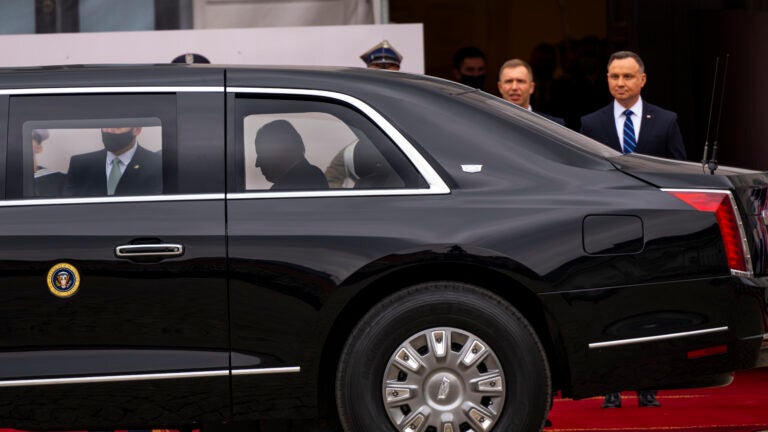
Russia-Ukraine “If we want to do this, we mustn’t escalate, neither with words nor with actions.” President Joe Biden arrives in his limousine for an arrival ceremony with President Andrzej Duda of Poland, right, at the Presidential Palace in Warsaw, Poland, March 26, 2022. (Doug Mills/The New York Times) By Emma Bubola, New York Times Service March 27, 2022 | 6:08 PM After President Joe Biden called President Vladimir Putin of Russia a “butcher” and said he could not remain in power, European officials reacted with a mix of rejection and admiration. The French and British governments distanced themselves from Biden’s remarks and the prospect of regime change, while others welcomed his blunt tone. “I wouldn’t use this kind of words,” President Emmanuel Macron of France said in a television interview Sunday after he was asked to comment on Biden’s speech. He said he hoped to obtain a cease-fire and the withdrawal of Russian troops from Ukraine through diplomacy. “If we want to do this, we mustn’t escalate,” he said, “neither with words nor with actions.” Britain’s government took a similar stance. “I think that is up to the Russian people,” Nadhim Zahawi, the education secretary, said in a television interview Sunday, when asked if the British government thought Putin should go. “The Russian people will decide the fate of Putin and his cronies.” He added that he was sure that both the United States and Britain agreed that the Russian people should decide how they wished to be governed, echoing the White House’s clarification that the president’s speech was not calling for regime change. Tobias Ellwood, a conservative British member of Parliament, said Biden’s comment was unwise. “It’s for the Russian people to draw this (obvious) conclusion,” he wrote on Twitter. “Putin will spin this, dig in and fight harder.” Unwise comment: It’s for the Russian people to draw this (obvious) conclusion. Putin /Xi (& many Russians) will now read ‘regime change’ as POTUS’ wider objective – beyond supporting Ukraine. Putin will spin this, dig in and fight harder. pic.twitter.com/GEbc41Aa8L — Tobias Ellwood MP (@Tobias_Ellwood) March 26, 2022 On Saturday, Dmitry Peskov, the Kremlin spokesperson, said it was not for Biden to decide who the Russian president should be. Vyacheslav Volodin, a senior Russian lawmaker, wrote on Telegram that neither Boris Yeltsin nor Mikhail Gorbachev, who ruled during the Cold War, were the target of similar comments by American heads of state. “The reason for this behavior will be more professionally explained by psychiatrists,” Volodin said. “U.S. citizens should be ashamed of their President.” Many in the West worried that Russia would try to use Biden’s remarks to its advantage. The comment risked “turning the war for the defense of Ukraine to a familiar one of American aggression,” Patrick Wintour, the Guardian’s diplomatic editor, wrote Sunday, “Any unseating of Russia’s president is that country’s business, not that of the U.S. president.” He called the remarks “a badly needed gift” to a Russian government that is skilled at depicting the United States as an “imperialistic bully.” He said it also made it harder for mediators of the crisis, such as Turkey, Qatar and China, to persuade Putin to turn back. René Pfister, Washington bureau chief for German newspaper Der Spiegel, also criticized Biden. “Joe Biden has the special talent of tearing down with his loose mouth what he has previously worked hard to build up,” Pfister wrote. “But now it’s not about a failed election campaign slogan, but about war and peace.” Italian officials and commentators had a more favorable view of Biden’s remarks. Biden had used words “that must make Putin clearly understand that he has to stop,” the foreign minister, Luigi Di Maio, said on Italian television Saturday night. Biden, he said, made “a very clear speech; he used resolute words. But let’s remember that on the other side, Putin uses bombs.” Jacopo Iacoboni, an Italian journalist and a prominent critic of the Russian government who usually opposes Di Maio’s party, the 5-Star Movement, agreed. “You might criticize Biden in many ways, but is there any European leader who says, clearly, this simple truth?” he wrote on Twitter. “Putin cannot stay in power.” Maurizio Molinari, director of the La Repubblica newspaper, wrote in an editorial that Biden’s words reflected the objective of the pro-Ukraine coalition. “Sanctions will stay in place,” he wrote, “as long as ‘the war criminal’ stays in power.”This article originally appeared in The New York Times. Boston.com Today Get news delivered to your inbox each morning. In Related News