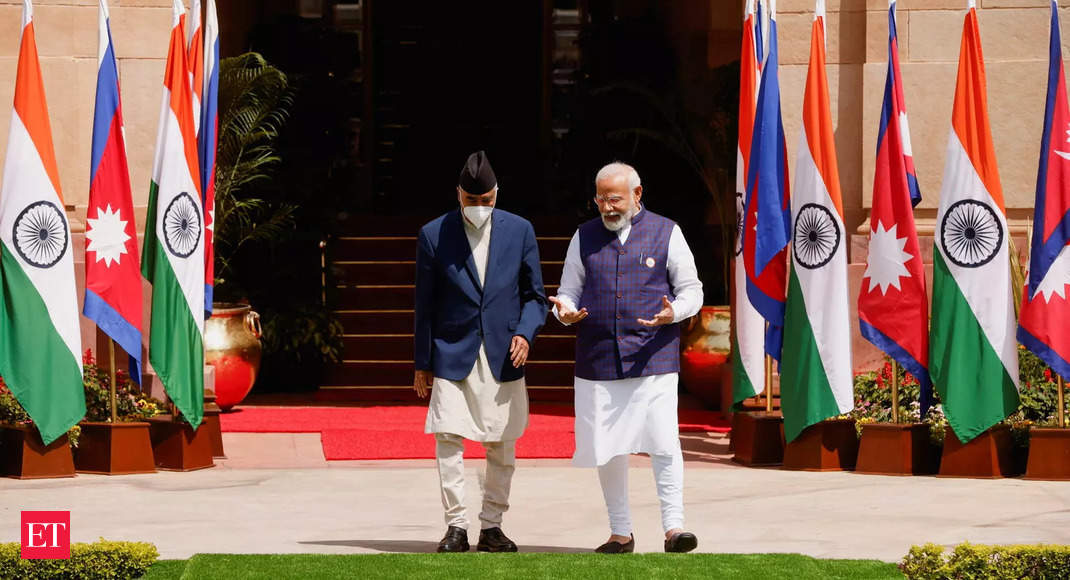
India’s role in Nepal’s development projects got a fillip on Saturday with the launch of a cross-border railway link and power transmission line, besides inauguration of the ‘Joint Vision Statement on Power Sector Cooperation’ that has the potential to create a second Bhutan model in cross-border power trade.
The documents for cross-border railway and power projects were launched at the summit between visiting Nepal Prime Minister Sher Bahadur Deuba and Prime Minister Narendra Modi.
Besides development projects, boundary issues were also discussed in detail at the summit.
Deuba, who is visiting India from 1-3 April, said they discussed “boundary issues” and that he urged his Indian counterpart to resolve all disputes through “bilateral mechanisms”. Besides official engagements, Deuba will also visit Varanasi.
Modi said the two sides discussed that “open borders” between India and Nepal should not be misused by “undesirable elements”. While Modi did not name who he referred to as “undesirable elements”, the hint was likely towards Pakistan-based extremists and radicals, as well as criminal networks involved in fake currency and other contraband items.
“We laid emphasis on deepening cooperation between our defence and security authorities. I am confident that our conversation will be able to attain the objective of achieving the ambitious targets of the India-Nepal relations,” Modi said.
Modi announced that they have agreed to strengthen cooperation in the power sector and have finalised a joint vision statement on power cooperation, which will act as a blueprint for the future. The two sides, he informed, will also prioritise trade and cross-border connectivity. They also launched the Rupay card in Nepal, which will start a new chapter on financial connectivity, Modi said.
(Catch all the Business News, Breaking News Events and Latest News Updates on The Economic Times.)
Download The Economic Times News App to get Daily Market Updates & Live Business News.
India’s role in Nepal’s development projects got a fillip on Saturday with the launch of a cross-border railway link and power transmission line, besides inauguration of the ‘Joint Vision Statement on Power Sector Cooperation’ that has the potential to create a second Bhutan model in cross-border power trade. The documents for cross-border railway and power projects were launched at the summit between visiting Nepal Prime Minister Sher Bahadur Deuba and Prime Minister Narendra Modi. Besides development projects, boundary issues were also discussed in detail at the summit. Deuba, who is visiting India from 1-3 April, said they discussed “boundary issues” and that he urged his Indian counterpart to resolve all disputes through “bilateral mechanisms”. Besides official engagements, Deuba will also visit Varanasi. Modi said the two sides discussed that “open borders” between India and Nepal should not be misused by “undesirable elements”. While Modi did not name who he referred to as “undesirable elements”, the hint was likely towards Pakistan-based extremists and radicals, as well as criminal networks involved in fake currency and other contraband items. “We laid emphasis on deepening cooperation between our defence and security authorities. I am confident that our conversation will be able to attain the objective of achieving the ambitious targets of the India-Nepal relations,” Modi said. Modi announced that they have agreed to strengthen cooperation in the power sector and have finalised a joint vision statement on power cooperation, which will act as a blueprint for the future. The two sides, he informed, will also prioritise trade and cross-border connectivity. They also launched the Rupay card in Nepal, which will start a new chapter on financial connectivity, Modi said. (Catch all the Business News, Breaking News Events and Latest News Updates on The Economic Times.)Download The Economic Times News App to get Daily Market Updates & Live Business News.