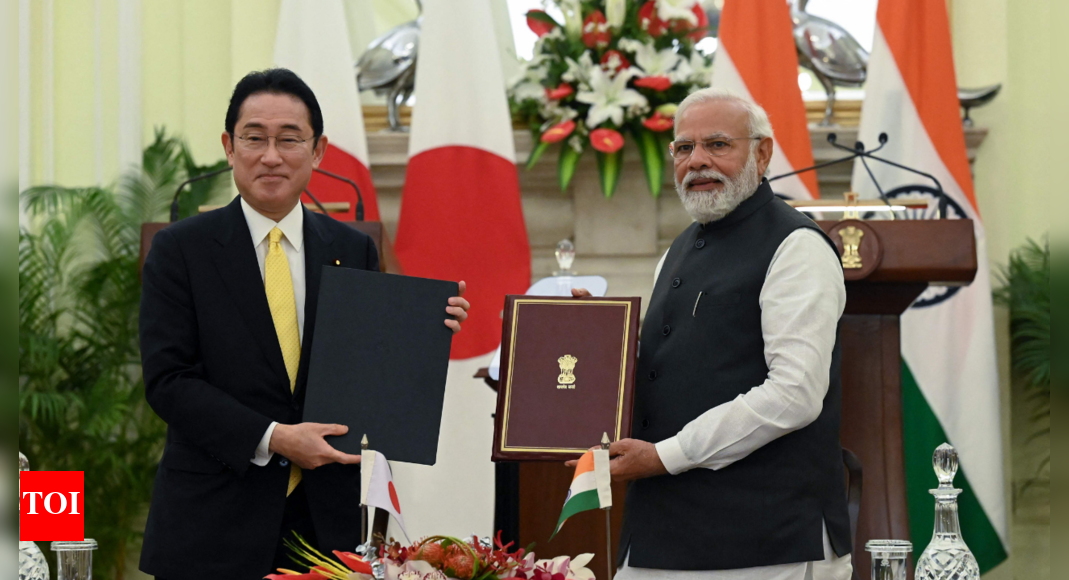
Prime Minister Narendra Modi (R) and Japan’s Prime Minister Fumio Kishida pose for pictures after the signing of an agreement in New Delhi (AFP)
NEW DELHI: Ukraine and China were among the issues that dominated the agenda for PM Modi’s first summit meeting with his Japanese counterpart, Fumio Kishida, even as the two countries announced investments worth close to $42 billion by Japan in India over five years, surpassing the $33 billion announced by Tokyo in 2014.
Seeking a common stand on Russia’s action against Ukraine, Kishida, according to a Japanese spokesperson, sought cooperation from Modi in convincing Vladimir Putin to maintain a “free & open international order”.
According to the spokesperson, Kishida said that as a victim of nuclear attack, Japan believes any nuclear threat, let alone its use, cannot be tolerated.
While PM Modi didn’t mention Ukraine in his press statement, Kishida said he had told Modi any attempt to unilaterally change the status quo anywhere should never be tolerated. Japan claimed there was an agreement with India on this issue even though it wasn’t confirmed by any Indian official.
An India-Japan joint statement underlined the significance of international law and the need to resolve disputes without any use of force or any attempt to unilaterally change the status quo, even though it didn’t name Russia or Ukraine. Apart from the need to prevent any attempt to unilaterally change the status quo, Japan said the two nations had also agreed on three points, namely the need for a peaceful solution, immediate cessation of violence and humanitarian assistance for Ukraine.
He said Russia’s invasion is a serious issue that has shaken the international order and that there is a need for a peaceful solution on the basis of international law.
Foreign secretary Harsh Shringla said the “important” issue figured in the meeting and that Modi and Kishida sought immediate cessation of violence along with dialogue and diplomacy to resolve the crisis. The joint statement said the leaders expressed concern about the ongoing conflict and humanitarian crisis in Ukraine and assessed its broader implications, particularly for the Indo-Pacific region.
As per Shringla, the Indian side briefed Japan about China’s amassing of troops along the LAC and underscored India’s position that there can’t be “business as usual” or “normalcy” with China till the ongoing military stand-off is resolved. This is significant as Chinese foreign minister Wang Yi is likely to visit India next week.
India and Japan signed six agreements, including one for cybersecurity cooperation, and launched a sustainable development initiative for India’s northeast and a clean energy partnership. The statement said the two leaders highlighted their commitment to working in tandem towards a peaceful and stable world on a rules-based order that “respects sovereignty and territorial integrity of nations”.
PM Modi expressed happiness that the $33 billion Japanese investment target as announced in 2014 had been achieved and said that, building upon their aspirations, there was a new target of $42 billion over the next five years that will allow greater involvement of Japanese firms in Indian economy.
China’s activities in East and South China Sea also figured in the talks with both sides reaffirming their determination to continue prioritising the role of international law, particularly UNCLOS, and facilitate collaboration, including in maritime security, to meet challenges against the rules-based maritime order.
FOLLOW US ON SOCIAL MEDIA
Prime Minister Narendra Modi (R) and Japan’s Prime Minister Fumio Kishida pose for pictures after the signing of an agreement in New Delhi (AFP)NEW DELHI: Ukraine and China were among the issues that dominated the agenda for PM Modi’s first summit meeting with his Japanese counterpart, Fumio Kishida, even as the two countries announced investments worth close to $42 billion by Japan in India over five years, surpassing the $33 billion announced by Tokyo in 2014. Seeking a common stand on Russia’s action against Ukraine, Kishida, according to a Japanese spokesperson, sought cooperation from Modi in convincing Vladimir Putin to maintain a “free & open international order”. According to the spokesperson, Kishida said that as a victim of nuclear attack, Japan believes any nuclear threat, let alone its use, cannot be tolerated. While PM Modi didn’t mention Ukraine in his press statement, Kishida said he had told Modi any attempt to unilaterally change the status quo anywhere should never be tolerated. Japan claimed there was an agreement with India on this issue even though it wasn’t confirmed by any Indian official. An India-Japan joint statement underlined the significance of international law and the need to resolve disputes without any use of force or any attempt to unilaterally change the status quo, even though it didn’t name Russia or Ukraine. Apart from the need to prevent any attempt to unilaterally change the status quo, Japan said the two nations had also agreed on three points, namely the need for a peaceful solution, immediate cessation of violence and humanitarian assistance for Ukraine. He said Russia’s invasion is a serious issue that has shaken the international order and that there is a need for a peaceful solution on the basis of international law. Foreign secretary Harsh Shringla said the “important” issue figured in the meeting and that Modi and Kishida sought immediate cessation of violence along with dialogue and diplomacy to resolve the crisis. The joint statement said the leaders expressed concern about the ongoing conflict and humanitarian crisis in Ukraine and assessed its broader implications, particularly for the Indo-Pacific region. As per Shringla, the Indian side briefed Japan about China’s amassing of troops along the LAC and underscored India’s position that there can’t be “business as usual” or “normalcy” with China till the ongoing military stand-off is resolved. This is significant as Chinese foreign minister Wang Yi is likely to visit India next week. India and Japan signed six agreements, including one for cybersecurity cooperation, and launched a sustainable development initiative for India’s northeast and a clean energy partnership. The statement said the two leaders highlighted their commitment to working in tandem towards a peaceful and stable world on a rules-based order that “respects sovereignty and territorial integrity of nations”. PM Modi expressed happiness that the $33 billion Japanese investment target as announced in 2014 had been achieved and said that, building upon their aspirations, there was a new target of $42 billion over the next five years that will allow greater involvement of Japanese firms in Indian economy. China’s activities in East and South China Sea also figured in the talks with both sides reaffirming their determination to continue prioritising the role of international law, particularly UNCLOS, and facilitate collaboration, including in maritime security, to meet challenges against the rules-based maritime order. FOLLOW US ON SOCIAL MEDIA