02:21
Introduction: Stocks tumble, oil soars after Putin orders troops into Ukraine
Good morning, and welcome to our rolling coverage of the world economy, the financial markets, the eurozone and business.
The deepening Ukraine crisis has sent global stocks tumbling and crude oil surging. Last night, Russian president Vladimir Putin ordered his military to enter the Russian-controlled areas of southeast Ukraine. In a lengthy televised address, he had recognised the territories of Donetsk and Luhansk as independent states.
Washington, European and other countries have condemned the move and threatened to impose tough sanctions.
Boris Johnson is chairing a meeting of the UK’s emergency Cobra committee this morning to sign off a package of sanctions against Russia. The initial signs were that the package would target “those complicit in the violation of Ukraine’s territorial integrity”.
You can read more on our Ukraine crisis live blog.
Financial markets are in for a torrid day. In Asia, Japan’s Nikkei lost 1.7%, Hong Kong’s Hang Sing tumbled 2.9%, the Shanghai Composite Index fell just over 1% and South Korea’s Kospi dropped 1.35%.
European and US markets are also braced for heavy losses at the opening bell.
On oil markets, Brent crude is marching towards $100 a barrel amid supply fears. It has gained more than $2, or 2.2%, to $97.51 a barrel while US light crude has jumped $3.60 to $94.67 a barrel, a gain of nearly 4%.
Viktor Szabo, an emerging market portfolio manager at abrdn in London, told Reuters last night:
It is probably an understatement to say that it will be an ugly day [on the markets]. I was hoping we weren’t going to get here, but this is a significant step.
Russian markets were still trading when Putin announced his decision live on television following phone calls to the leaders of Germany and France.
The rouble dropped 3.3%, falling past 80 against the dollar, while Moscow’s stock markets plummeted to their lowest level in over a year. The dollar-denominated RTS index ended the day 13.2% lower while the rouble-based MOEX Russian index lost 10.5%.
Javier Blas
(@JavierBlas)While European capitals (and Washington) weigh how to respond to Putin, together EU-UK-US will buy over the next 24 hours ~3.5 million barrels of Russian oil and refined products, worth>$330 million at current prices. Add to that the gas, the aluminum, the nickel, etc…
The Agenda
- 9am GMT: Germany Ifo business climate survey (forecast: 96.5)
- 9am GMT: Italy inflation final for January (forecast: 4.8%)
- 10.45am GMT: Bank of England deputy governor Dave Ramsden gives speech
- 11am GMT: CBI Industrial trends survey for February
- 2pm GMT: US House prices for December
- 2.45pm GMT: US Markit PMIs for February (manufacturing, services and composite)
- 3pm GMT: US Consumer Confidence for February (forecast: 110)
Updated
09:02
GSK: new consumer company to be called Haleon
GSK has revealed that its consumer healthcare business will be called Haleon after its planned spinoff and London stock market listing this summer. Its brands include Sensodyne toothpaste and Voltaren and Panadol painkillers. The drugmaker said:
Haleon (pronounced “Hay-Lee-On”) is inspired by the merging of the words ‘Hale’, which is an old English word that means ‘in good health’ and Leon, which is associated with the word ‘strength’.
The business has grown in size after merging with consumer product portfolios from Novartis and Pfizer, and now generates annual sales of £10bn.
Brian McNamara, chief executive designate of Haleon, said:
Introducing Haleon to the world marks another step in our journey to become a new, standalone company. Our name is grounded in our purpose to deliver better everyday health with humanity and to be a world leader in consumer healthcare. We are on track to launch Haleon in mid-2022 and our business momentum is strong. We look forward to updating investors and analysts more on this at our capital markets event at the end of February.
Emma Walmsley, GSK’s chief executive, reiterated that Haleon had “strong prospects forgrowth, and through listing will unlock significant value for GSK shareholders”. She has been under pressure from the activist investor Elliott Management, a New York hedge fund, to explore a sale of the business, rather than a spin-off.
Haleon logo Photograph: GSK
08:46
Our economics editor Larry Elliott has spoken to Kristalina Georgieva, the managing director of the International Monetary Fund. He asked her about Russia and she expressed concerns about the possible impact on the global economy. She said:
It is very concerning. It adds to uncertainty at a time when there is plenty of it, because we are not yet done with the pandemic and because the path to recovery for many countries is a difficult one.
Georgieva said the tension had already had an impact on Ukraine through investors becoming more “hesitant” and said sanctions would have an impact on Russia and neighbouring countries.
I anticipate an impact on Russia and through it an impact on Central Asia and the Caucasus – countries more dependent on economic ties with Russia.
On the impact on the global economy, Georgieva said it would depend on how the crisis unfolded.
I still hope there is a path to avoid a more dramatic impact. A more profound development could put pressure on energy prices to go higher. It is happening at a time when there are more risks for the world economy. Aggravating those risks is in nobody’s interests.

Taro Aso, Japan’s deputy prime minister and finance minister, presents a gift of a manga comic to Kristalina Georgieva, managing director of the IMF. Photograph: Hollie Adams/EPA
08:32
The FTSE 100 index is holding on to its meagre gains, trading 17 points, or 0.2%, higher at 7,501, while Europe’s other main indices are flat to slightly lower.
In London, the Russian miner Evraz fell more than 4% this morning but is now the top riser, up 4.8% at 280p.
Michael Hewson 🇬🇧
(@mhewson_CMC)Russian miner Evraz started today, down over 4% and worst performer on the FTSE100
Now best performer on FTSE100, up 5%.
Not sure that’s how this sanctions lark is supposed to work?
08:22
Jess Ralston, analyst at the energy and climate intelligence unit, a non-profit organisation, warned about the impact on UK (and European) households:
Gas prices are already surging and with Germany putting a halt to Nord Stream 2, the gas crisis now looks almost certain to last for years, not months.
Given the global nature of gas markets, the UK’s dependence on gas for heating and power will leave UK bill payers on the hook for Putin’s incursion into Ukraine. The government will increasingly feel the pressure to shield households in the long-term by insulating more homes, speeding the switch over to electric heat pumps and getting on with delivering the net zero policies that will wean us off volatile gas and protect us from future crises.
08:10
Here is our full story on Germany stopping the certification process for the controversial Nord Stream 2 gas pipeline in reaction to Russia’s recognition of the self-proclaimed republics in Luhansk and Donetsk in east Ukraine, by our man in Berlin, Philip Oltermann.
Germany’s chancellor Olaf Scholz described Putin’s recognition of the Russian-controlled territories as a “grave breach” of international law that broke with decades of agreements between Russia and the west. “The situation today is fundamentally different,” he said.
European natural gas contracts rose 9.5% to €78 a megawatt hour after the announcement from Scholz.
Updated
08:04
UK sanctions five Russian banks and three individuals
The UK has imposed sanctions on five Russian banks and three high-net worth individuals, including Vladimir Putin’s close ally Gennady Timchenko, a Russian oligarch and billionaire businessman. The move comes after the Russian president ordered troops into eastern Ukraine last night, and formally recognised the territories of Donetsk and Luhansk as independent states.
The banks are: Rossiya, IS Bank, General Bank, Promsvyazbank and the Black Sea Bank.
Boris Johnson told parliament:
This is the first tranche, the first barrage of what we are prepared to do.
Any assets they hold in the UK will be frozen and the individuals concerned will be banned from travelling here.
We must now brace ourselves for the next possible stages of Putin’s plan. Putin is establishing the pretx for a full-scale offensive.
Britain has also previously threatened to block Russian companies from raising capital in London and to expose what Johnson calls the “Matryoshka dolls of Russian-owned companies”.
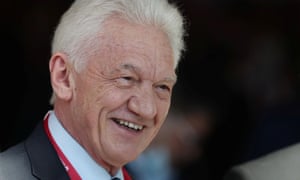
Russian businessman, Volga Group founder Gennady Timchenko attends the St. Petersburg International Economic Forum in Saint Petersburg, Russia, June 4, 2021. Photograph: Evgenia Novozhenina/Reuters
Caroline Lucas
(@CarolineLucas)Is that it?
Sanctioning 5 banks and 3 oligarchs suggests the Government cares more about protecting Tory party donations and London’s laundromat than it does about imposing meaningful sanctions against Moscow#Ukrainecrisis
Updated
07:38
Joanna Partridge
More on Dave Ramsden’s comments from Joanna Partridge, who is at the National Farmers’ Union’s annual conference:
Inflation, rising energy prices and the intensification of the crisis in Ukraine are among the string of challenges facing farmers and businesses in the current “age of uncertainty”, according to Bank of England policymaker Sir David Ramsden.
Speaking to English and Welsh food producers at the annual conference of the National Farmers’ Union, the Bank’s deputy governor said “on inflation I haven’t seen such a challenging set of circumstances as this”.
He added:
The shock of the decision to leave EU, then the pandemic two years ago, now the energy price shock and intensification of the crisis in Ukraine, are creating uncertainty about where we go next. This does feel like the age of uncertainty.
Fruit grower Ali Capper, chair of English Apples and Pears, told Ramsden that farmers in her sector are facing significantly higher costs this year, and will potentially have to pay workers 40% higher wages in 2022 than a year earlier. He said:
The shocks that are coming in terms of fertiliser prices and other input prices are very, very significant. You are facing much higher inflation rates than I am seeing as a monetary policymaker in the economy as a whole.
He said the best thing which could be done by the Bank – which expects inflation to peak at around 7.25% in April when the impending rise in the energy price cap takes effect – was to stick to its plans to maintain financial stability.
Ramsden, whose mother was raised on a Welsh hill farm, also revealed he had watched TV presenter Jeremy Clarkson’s attempts to become a farmer on series Clarkson’s Farm, where Clarkson was surprised that he was judged to be a key worker during Covid.
Updated
06:57
European shares have see-sawed: they are now back in the red with the exception of the UK’s FTSE 100 index, which is 21 points ahead at 7,505, a 0.28% gain.
06:56
BOE’s Ramsden: more ‘modest’ rate rises in coming months
Meanwhile, Bank of England deputy governor Dave Ramsden said that there will be further interest rate rises in the months to come as the central bank responds to soaring inflation. But he said the longer-term path was hard to predict because of heightened uncertainty, including the Russia-Ukraine conflict.
Ramsden said in a keynote speech at the National Farmers’ Union’s annual conference:
Some further modest tightening in monetary policy is likely to be appropriate in the coming months.
The word ‘modest’ is significant here though – I do not envisage Bank Rate rising to anything like its pre-2007 level of 5% or above, let alone to the kind of levels we used to see before the monetary policy committee was formed in 1997.
New shocks can arise – we did not foresee the recent rise in energy prices, and as we meet today the crisis in Ukraine is intensifying – and so we should remain humble about the possibility that things might turn out differently.
[This] makes it particularly difficult to make predictions about where monetary policy might be headed in the medium term.
Investors are expecting a further rate hike after the Bank’s next scheduled meeting on 17 March, following two increases in February and December, to 0.5% now. Financial markets have priced in rates rising to nearly 2% by the end of the year.
UK inflation jumped to 5.5% in January, its highest level in nearly three decades, and the Bank expects it to peak at 7.25% in April when a 54% hike in household energy bills comes into effect.
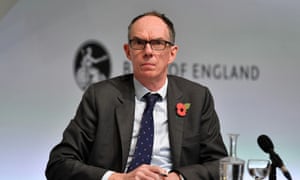
Bank of England Deputy Governor for Markets and Banking Dave Ramsden attends the Monetary Policy Report Press Conference in November. Photograph: Reuters
06:41
Germany has taken steps to halt the process of certifying the Nord Stream 2 gas pipeline from Russia, chancellor Olaf Scholz said today, as the West started taking punitive measures against Moscow over the Ukraine crisis, AP reports.
Scholz told reporters in Berlin that his government was taking the measure in response to Moscow’s actions in Ukraine.
The decision is a significant move for the German government, which had long resisted pulling the plug on the project despite pressure from the United States and some European countries to do so. Washington has for years argued that building another pipeline bringing natural gas from Russia to Germany increases Europe’s reliance on Russian energy supplies.
Scholz said that the government had decided to “reassess” the certification of the pipeline, which hasn’t begun operating yet, in light of the latest developments.
“That will certainly take time, if I may say so,” he said.
Germany meets about a quarter of its energy needs with natural gas, a share that will increase in the coming years as the country switches off its last three nuclear power plants and phases out the use of coal. About half of the natural gas used in Germany comes from Russia.
06:26
Adam Schwarz
(@AdamJSchwarz)This is a massive geopolitical decision by Scholz and will be one of the biggest of his chancellorship.
An indication European leaders are willing to make huge national economic sacrifices to free their nations from dependence on Russian hydrocarbons. https://t.co/DwFtShNuJE
Investing.com
(@Investingcom)*GERMAN CHANCELLOR SCHOLZ SAYS CERTIFICATION OF NORD STREAM 2 CANNOT GO AHEAD GIVEN RUSSIA’S LATEST ACTIONS pic.twitter.com/jTXWynLbOg
06:17
Germany pulls plug on Nord Stream 2 pipeline
BREAKING: Germany has pulled the plug on the Nord Stream 2 gas pipeline, according to the chancellor Olaf Scholz.
Michaela Kuefner
(@MKuefner)BREAKING Chancellor Olaf Scholz pulls the plug on Nord Stream 2 pipeline with Russia over Putin’s “blatant breach of international law”.
Scholz had avoided mentioning the pipeline to keep diplomatic channels with Moscow open but stresses now a “fundamentally different situation” pic.twitter.com/v6dCGeKj7q
Updated
06:15
Market round-up: UK, European shares turn positive
The UK and Europe’s main stock markets have turned positive after suffering heavy losses (of more than 2% on the German, Italian and Spanish stock indices) in early trading. The UK’s FTSE 100 is up 29 points, or 0.4%, at 7,513 while the other exchanges are broadly flat.
Brent crude, the global benchmark for Russia’s main export (oil), ventured above $99 a barrel earlier but is now trading at $98.15, up 2.9%.
Russia’s two main stock indices are still trading lower. The dollar-denominated RTS index has fallen 3.5% after yesterday’s 13.2% plunge, while the rouble-denominated Moex index is down 3.86% following last night’s 10.5% drop.
The Russian rouble fell to a near two-year low of 81 to the dollar, but has now recovered to 78.88. Ukraine’s hryvnia currency has fallen to a seven-year low, trading at 28.9 to the dollar.
Updated
05:40
News round-up
Here is our full story on what’s going on in financial markets.
And a round-up of our other main stories:
HSBC boosted its banker bonus pool by nearly a third after a global recovery from the Covid crisis helped profits more than double last year.
The London-headquartered bank increased its staff bonus pool to $3.5bn (£2.6bn), a move it said was justified due to its strong financial performance and the need to compete for bankers in an “extraordinarily competitive labour market”.
The UK government has recorded the first monthly budget surplus since the start of the coronavirus pandemic, despite a weaker than expected January performance as rising inflation pushed up debt interest costs.
The Office for National Statistics said public sector net borrowing was in surplus of £2.9bn last month – the first month in which income outstripped expenditure since January 2020.
Hundreds of thousands of tonnes of surplus food that could be going to hungry families is going to waste as supermarkets restrict who their suppliers can give it to, according to food distribution charities.
Several independent charities, which are grouped together under the Xcess network, say they struggle to source unwanted edible food from manufacturers and processors because of supermarkets’ rules about the handling of their own-label products.
The number of women in FTSE 100 boardroom roles has jumped to 39.1% from 12.5% 10 years ago, data has revealed, even as equality charities said progress for women in senior leadership roles was severely lagging.
And in our Suisse secrets series, our banking correspondent Kalyeena Makortoff has looked at how Swiss banking secrecy enabled an unequal global financial system.
Updated
05:30
There are fresh calls on the UK government to clamp down on Russian influence in UK finance and politics.
The UK capital is also known as “Londongrad”. Last month ministers were criticised by MPs from all parties for failing to tackle London’s reputation as a money-laundering hub used by Russian oligarchs, criminals and kleptocrats.
Caroline Lucas, Green MP for Brighton Pavilion, and a former party leader, has tweeted:
Caroline Lucas
(@CarolineLucas)Vital to stand in solidarity with Ukraine in face of outrageous Russian aggression with robust, far-reaching sanctions & closing London’s shameful money laundering machine. Govt should’ve done much more to prevent Russian interference in UK politics, incl donations to Tory party
05:15
Russia’s move against Ukraine has massively increased the uncertainty around the economic outlook for the eurozone, according to the European Economic Commissioner Paolo Gentiloni.
He said at an economic conference today that “uncertainty remains around us,” adding:
The violation of international law through Russian recognition of two separate territories in Ukraine will strongly increase this uncertainty.
The European Commission already cut its growth forecast for the 19-nation currency bloc to 4% this year from 4.3% earlier this month, citing a new wave of Covid-19 infections, soaring energy prices and ongoing supply chain problems.
BBC News (World)
(@BBCWorld)Russian President Vladimir Putin announces that he is recognising the independence of two breakaway regions of Ukraine, Donetsk and Luhansk
This has been has been met with condemnation by Nato and Western countrieshttps://t.co/WZJeQJaWnp pic.twitter.com/Po1FmFI6mo
05:02
German business morale improved in February across all sectors, according to a closely-watched monthly survey from the Munich-based Ifo institute.
Its business climate index rose to 98.9 from an upwardly revised 96.0 in January, marking the highest level since August. This was better than economists had expected.
Commerzbank’s chief economist Jörg Krämer said:
The results of the February Ifo survey are a clear sign that the German economy will benefit massively from the easing of the coronavirus crisis in the coming months.
However, the Ukraine crisis hangs over Europe’s largest economy “like the sword of Damocles,” experts said.
Ifo economist Klaus Wohlrabe told Reuters that “the uncertainty will increase massively” and the biggest risk for German companies comes from soaring energy prices. “That would be poison for the [economic] recovery.”
ING economist Carsten Brzeski said:
We don’t want to speculate about the next steps in the Russia-Ukraine crisis, but it is clear that the new uncertainty will weigh on business sentiment, dent purchasing power if energy prices continue to increase, and could eventually also, temporarily, subdue business investment.
Updated
04:52
Natural gas prices jump; aluminium and nickel hit multi-year highs
Natural gas prices jumped 7%, despite assurances from the Russian president that Russia will continue to deliver uninterrupted natural gas supplies to world markets. He made the pledge in a letter to an energy conference in Doha.
British wholesale gas for next-day delivery rose 7% to 183p per therm this morning.
The United States and its European allies are set to announce fresh sanctions on Russia today, after Vladimir Putin ordered Russian troops to march into eastern Ukraine.
Fears of supply disruption have sent London-traded metal prices surging. Aluminium hit a more than 13-year high of $3,350 a tonne while benchmark nickel prices reached the highest level since August 2011.
Updated
02:21 Introduction: Stocks tumble, oil soars after Putin orders troops into Ukraine Good morning, and welcome to our rolling coverage of the world economy, the financial markets, the eurozone and business. The deepening Ukraine crisis has sent global stocks tumbling and crude oil surging. Last night, Russian president Vladimir Putin ordered his military to enter the Russian-controlled areas of southeast Ukraine. In a lengthy televised address, he had recognised the territories of Donetsk and Luhansk as independent states. Washington, European and other countries have condemned the move and threatened to impose tough sanctions. Boris Johnson is chairing a meeting of the UK’s emergency Cobra committee this morning to sign off a package of sanctions against Russia. The initial signs were that the package would target “those complicit in the violation of Ukraine’s territorial integrity”. You can read more on our Ukraine crisis live blog. Financial markets are in for a torrid day. In Asia, Japan’s Nikkei lost 1.7%, Hong Kong’s Hang Sing tumbled 2.9%, the Shanghai Composite Index fell just over 1% and South Korea’s Kospi dropped 1.35%. European and US markets are also braced for heavy losses at the opening bell. On oil markets, Brent crude is marching towards $100 a barrel amid supply fears. It has gained more than $2, or 2.2%, to $97.51 a barrel while US light crude has jumped $3.60 to $94.67 a barrel, a gain of nearly 4%. Viktor Szabo, an emerging market portfolio manager at abrdn in London, told Reuters last night: It is probably an understatement to say that it will be an ugly day [on the markets]. I was hoping we weren’t going to get here, but this is a significant step. Russian markets were still trading when Putin announced his decision live on television following phone calls to the leaders of Germany and France. The rouble dropped 3.3%, falling past 80 against the dollar, while Moscow’s stock markets plummeted to their lowest level in over a year. The dollar-denominated RTS index ended the day 13.2% lower while the rouble-based MOEX Russian index lost 10.5%. Javier Blas (@JavierBlas) While European capitals (and Washington) weigh how to respond to Putin, together EU-UK-US will buy over the next 24 hours ~3.5 million barrels of Russian oil and refined products, worth>$330 million at current prices. Add to that the gas, the aluminum, the nickel, etc… February 21, 2022 The Agenda 9am GMT: Germany Ifo business climate survey (forecast: 96.5) 9am GMT: Italy inflation final for January (forecast: 4.8%) 10.45am GMT: Bank of England deputy governor Dave Ramsden gives speech 11am GMT: CBI Industrial trends survey for February 2pm GMT: US House prices for December 2.45pm GMT: US Markit PMIs for February (manufacturing, services and composite) 3pm GMT: US Consumer Confidence for February (forecast: 110) Updated at 5.47am EST 9.02am EST 09:02 GSK: new consumer company to be called Haleon GSK has revealed that its consumer healthcare business will be called Haleon after its planned spinoff and London stock market listing this summer. Its brands include Sensodyne toothpaste and Voltaren and Panadol painkillers. The drugmaker said: Haleon (pronounced “Hay-Lee-On”) is inspired by the merging of the words ‘Hale’, which is an old English word that means ‘in good health’ and Leon, which is associated with the word ‘strength’. The business has grown in size after merging with consumer product portfolios from Novartis and Pfizer, and now generates annual sales of £10bn. Brian McNamara, chief executive designate of Haleon, said: Introducing Haleon to the world marks another step in our journey to become a new, standalone company. Our name is grounded in our purpose to deliver better everyday health with humanity and to be a world leader in consumer healthcare. We are on track to launch Haleon in mid-2022 and our business momentum is strong. We look forward to updating investors and analysts more on this at our capital markets event at the end of February. Emma Walmsley, GSK’s chief executive, reiterated that Haleon had “strong prospects forgrowth, and through listing will unlock significant value for GSK shareholders”. She has been under pressure from the activist investor Elliott Management, a New York hedge fund, to explore a sale of the business, rather than a spin-off. Haleon logo Photograph: GSK 8.46am EST 08:46 Our economics editor Larry Elliott has spoken to Kristalina Georgieva, the managing director of the International Monetary Fund. He asked her about Russia and she expressed concerns about the possible impact on the global economy. She said: It is very concerning. It adds to uncertainty at a time when there is plenty of it, because we are not yet done with the pandemic and because the path to recovery for many countries is a difficult one. Georgieva said the tension had already had an impact on Ukraine through investors becoming more “hesitant” and said sanctions would have an impact on Russia and neighbouring countries. I anticipate an impact on Russia and through it an impact on Central Asia and the Caucasus – countries more dependent on economic ties with Russia. On the impact on the global economy, Georgieva said it would depend on how the crisis unfolded. I still hope there is a path to avoid a more dramatic impact. A more profound development could put pressure on energy prices to go higher. It is happening at a time when there are more risks for the world economy. Aggravating those risks is in nobody’s interests. Taro Aso, Japan’s deputy prime minister and finance minister, presents a gift of a manga comic to Kristalina Georgieva, managing director of the IMF. Photograph: Hollie Adams/EPA 8.32am EST 08:32 The FTSE 100 index is holding on to its meagre gains, trading 17 points, or 0.2%, higher at 7,501, while Europe’s other main indices are flat to slightly lower. In London, the Russian miner Evraz fell more than 4% this morning but is now the top riser, up 4.8% at 280p. Michael Hewson 🇬🇧 (@mhewson_CMC) Russian miner Evraz started today, down over 4% and worst performer on the FTSE100Now best performer on FTSE100, up 5%. Not sure that’s how this sanctions lark is supposed to work? February 22, 2022 8.22am EST 08:22 Jess Ralston, analyst at the energy and climate intelligence unit, a non-profit organisation, warned about the impact on UK (and European) households: Gas prices are already surging and with Germany putting a halt to Nord Stream 2, the gas crisis now looks almost certain to last for years, not months. Given the global nature of gas markets, the UK’s dependence on gas for heating and power will leave UK bill payers on the hook for Putin’s incursion into Ukraine. The government will increasingly feel the pressure to shield households in the long-term by insulating more homes, speeding the switch over to electric heat pumps and getting on with delivering the net zero policies that will wean us off volatile gas and protect us from future crises. 8.10am EST 08:10 Here is our full story on Germany stopping the certification process for the controversial Nord Stream 2 gas pipeline in reaction to Russia’s recognition of the self-proclaimed republics in Luhansk and Donetsk in east Ukraine, by our man in Berlin, Philip Oltermann. Germany’s chancellor Olaf Scholz described Putin’s recognition of the Russian-controlled territories as a “grave breach” of international law that broke with decades of agreements between Russia and the west. “The situation today is fundamentally different,” he said. European natural gas contracts rose 9.5% to €78 a megawatt hour after the announcement from Scholz. Updated at 8.19am EST 8.04am EST 08:04 UK sanctions five Russian banks and three individuals The UK has imposed sanctions on five Russian banks and three high-net worth individuals, including Vladimir Putin’s close ally Gennady Timchenko, a Russian oligarch and billionaire businessman. The move comes after the Russian president ordered troops into eastern Ukraine last night, and formally recognised the territories of Donetsk and Luhansk as independent states. The banks are: Rossiya, IS Bank, General Bank, Promsvyazbank and the Black Sea Bank. Boris Johnson told parliament: This is the first tranche, the first barrage of what we are prepared to do. Any assets they hold in the UK will be frozen and the individuals concerned will be banned from travelling here. We must now brace ourselves for the next possible stages of Putin’s plan. Putin is establishing the pretx for a full-scale offensive. Britain has also previously threatened to block Russian companies from raising capital in London and to expose what Johnson calls the “Matryoshka dolls of Russian-owned companies”. Russian businessman, Volga Group founder Gennady Timchenko attends the St. Petersburg International Economic Forum in Saint Petersburg, Russia, June 4, 2021. Photograph: Evgenia Novozhenina/Reuters Caroline Lucas (@CarolineLucas) Is that it? Sanctioning 5 banks and 3 oligarchs suggests the Government cares more about protecting Tory party donations and London’s laundromat than it does about imposing meaningful sanctions against Moscow#Ukrainecrisis February 22, 2022 Updated at 8.34am EST 7.38am EST 07:38 Joanna Partridge More on Dave Ramsden’s comments from Joanna Partridge, who is at the National Farmers’ Union’s annual conference: Inflation, rising energy prices and the intensification of the crisis in Ukraine are among the string of challenges facing farmers and businesses in the current “age of uncertainty”, according to Bank of England policymaker Sir David Ramsden. Speaking to English and Welsh food producers at the annual conference of the National Farmers’ Union, the Bank’s deputy governor said “on inflation I haven’t seen such a challenging set of circumstances as this”. He added: The shock of the decision to leave EU, then the pandemic two years ago, now the energy price shock and intensification of the crisis in Ukraine, are creating uncertainty about where we go next. This does feel like the age of uncertainty. Fruit grower Ali Capper, chair of English Apples and Pears, told Ramsden that farmers in her sector are facing significantly higher costs this year, and will potentially have to pay workers 40% higher wages in 2022 than a year earlier. He said: The shocks that are coming in terms of fertiliser prices and other input prices are very, very significant. You are facing much higher inflation rates than I am seeing as a monetary policymaker in the economy as a whole. He said the best thing which could be done by the Bank – which expects inflation to peak at around 7.25% in April when the impending rise in the energy price cap takes effect – was to stick to its plans to maintain financial stability. Ramsden, whose mother was raised on a Welsh hill farm, also revealed he had watched TV presenter Jeremy Clarkson’s attempts to become a farmer on series Clarkson’s Farm, where Clarkson was surprised that he was judged to be a key worker during Covid. Updated at 7.45am EST 6.57am EST 06:57 European shares have see-sawed: they are now back in the red with the exception of the UK’s FTSE 100 index, which is 21 points ahead at 7,505, a 0.28% gain. 6.56am EST 06:56 BOE’s Ramsden: more ‘modest’ rate rises in coming months Meanwhile, Bank of England deputy governor Dave Ramsden said that there will be further interest rate rises in the months to come as the central bank responds to soaring inflation. But he said the longer-term path was hard to predict because of heightened uncertainty, including the Russia-Ukraine conflict. Ramsden said in a keynote speech at the National Farmers’ Union’s annual conference: Some further modest tightening in monetary policy is likely to be appropriate in the coming months. The word ‘modest’ is significant here though – I do not envisage Bank Rate rising to anything like its pre-2007 level of 5% or above, let alone to the kind of levels we used to see before the monetary policy committee was formed in 1997. New shocks can arise – we did not foresee the recent rise in energy prices, and as we meet today the crisis in Ukraine is intensifying – and so we should remain humble about the possibility that things might turn out differently. [This] makes it particularly difficult to make predictions about where monetary policy might be headed in the medium term. Investors are expecting a further rate hike after the Bank’s next scheduled meeting on 17 March, following two increases in February and December, to 0.5% now. Financial markets have priced in rates rising to nearly 2% by the end of the year. UK inflation jumped to 5.5% in January, its highest level in nearly three decades, and the Bank expects it to peak at 7.25% in April when a 54% hike in household energy bills comes into effect. Bank of England Deputy Governor for Markets and Banking Dave Ramsden attends the Monetary Policy Report Press Conference in November. Photograph: Reuters 6.41am EST 06:41 Germany has taken steps to halt the process of certifying the Nord Stream 2 gas pipeline from Russia, chancellor Olaf Scholz said today, as the West started taking punitive measures against Moscow over the Ukraine crisis, AP reports. Scholz told reporters in Berlin that his government was taking the measure in response to Moscow’s actions in Ukraine. The decision is a significant move for the German government, which had long resisted pulling the plug on the project despite pressure from the United States and some European countries to do so. Washington has for years argued that building another pipeline bringing natural gas from Russia to Germany increases Europe’s reliance on Russian energy supplies. Scholz said that the government had decided to “reassess” the certification of the pipeline, which hasn’t begun operating yet, in light of the latest developments. “That will certainly take time, if I may say so,” he said. Germany meets about a quarter of its energy needs with natural gas, a share that will increase in the coming years as the country switches off its last three nuclear power plants and phases out the use of coal. About half of the natural gas used in Germany comes from Russia. 6.32am EST 06:32 As a reminder, you can follow the latest developments in our Ukraine crisis live blog: 6.26am EST 06:26 Adam Schwarz (@AdamJSchwarz) This is a massive geopolitical decision by Scholz and will be one of the biggest of his chancellorship.An indication European leaders are willing to make huge national economic sacrifices to free their nations from dependence on Russian hydrocarbons. https://t.co/DwFtShNuJE February 22, 2022 Investing.com (@Investingcom) *GERMAN CHANCELLOR SCHOLZ SAYS CERTIFICATION OF NORD STREAM 2 CANNOT GO AHEAD GIVEN RUSSIA’S LATEST ACTIONS pic.twitter.com/jTXWynLbOg February 22, 2022 6.17am EST 06:17 Germany pulls plug on Nord Stream 2 pipeline BREAKING: Germany has pulled the plug on the Nord Stream 2 gas pipeline, according to the chancellor Olaf Scholz. Michaela Kuefner (@MKuefner) BREAKING Chancellor Olaf Scholz pulls the plug on Nord Stream 2 pipeline with Russia over Putin’s “blatant breach of international law”. Scholz had avoided mentioning the pipeline to keep diplomatic channels with Moscow open but stresses now a “fundamentally different situation” pic.twitter.com/v6dCGeKj7q February 22, 2022 Updated at 6.33am EST 6.15am EST 06:15 Market round-up: UK, European shares turn positive The UK and Europe’s main stock markets have turned positive after suffering heavy losses (of more than 2% on the German, Italian and Spanish stock indices) in early trading. The UK’s FTSE 100 is up 29 points, or 0.4%, at 7,513 while the other exchanges are broadly flat. Brent crude, the global benchmark for Russia’s main export (oil), ventured above $99 a barrel earlier but is now trading at $98.15, up 2.9%. Russia’s two main stock indices are still trading lower. The dollar-denominated RTS index has fallen 3.5% after yesterday’s 13.2% plunge, while the rouble-denominated Moex index is down 3.86% following last night’s 10.5% drop. The Russian rouble fell to a near two-year low of 81 to the dollar, but has now recovered to 78.88. Ukraine’s hryvnia currency has fallen to a seven-year low, trading at 28.9 to the dollar. Updated at 6.33am EST 5.40am EST 05:40 News round-up Here is our full story on what’s going on in financial markets. And a round-up of our other main stories: HSBC boosted its banker bonus pool by nearly a third after a global recovery from the Covid crisis helped profits more than double last year. The London-headquartered bank increased its staff bonus pool to $3.5bn (£2.6bn), a move it said was justified due to its strong financial performance and the need to compete for bankers in an “extraordinarily competitive labour market”. The UK government has recorded the first monthly budget surplus since the start of the coronavirus pandemic, despite a weaker than expected January performance as rising inflation pushed up debt interest costs. The Office for National Statistics said public sector net borrowing was in surplus of £2.9bn last month – the first month in which income outstripped expenditure since January 2020. Hundreds of thousands of tonnes of surplus food that could be going to hungry families is going to waste as supermarkets restrict who their suppliers can give it to, according to food distribution charities. Several independent charities, which are grouped together under the Xcess network, say they struggle to source unwanted edible food from manufacturers and processors because of supermarkets’ rules about the handling of their own-label products. The number of women in FTSE 100 boardroom roles has jumped to 39.1% from 12.5% 10 years ago, data has revealed, even as equality charities said progress for women in senior leadership roles was severely lagging. And in our Suisse secrets series, our banking correspondent Kalyeena Makortoff has looked at how Swiss banking secrecy enabled an unequal global financial system. Updated at 5.41am EST 5.30am EST 05:30 There are fresh calls on the UK government to clamp down on Russian influence in UK finance and politics. The UK capital is also known as “Londongrad”. Last month ministers were criticised by MPs from all parties for failing to tackle London’s reputation as a money-laundering hub used by Russian oligarchs, criminals and kleptocrats. Caroline Lucas, Green MP for Brighton Pavilion, and a former party leader, has tweeted: Caroline Lucas (@CarolineLucas) Vital to stand in solidarity with Ukraine in face of outrageous Russian aggression with robust, far-reaching sanctions & closing London’s shameful money laundering machine. Govt should’ve done much more to prevent Russian interference in UK politics, incl donations to Tory party February 22, 2022 5.15am EST 05:15 Russia’s move against Ukraine has massively increased the uncertainty around the economic outlook for the eurozone, according to the European Economic Commissioner Paolo Gentiloni. He said at an economic conference today that “uncertainty remains around us,” adding: The violation of international law through Russian recognition of two separate territories in Ukraine will strongly increase this uncertainty. The European Commission already cut its growth forecast for the 19-nation currency bloc to 4% this year from 4.3% earlier this month, citing a new wave of Covid-19 infections, soaring energy prices and ongoing supply chain problems. BBC News (World) (@BBCWorld) Russian President Vladimir Putin announces that he is recognising the independence of two breakaway regions of Ukraine, Donetsk and LuhanskThis has been has been met with condemnation by Nato and Western countrieshttps://t.co/WZJeQJaWnp pic.twitter.com/Po1FmFI6mo February 22, 2022 5.02am EST 05:02 German business morale improved in February across all sectors, according to a closely-watched monthly survey from the Munich-based Ifo institute. Its business climate index rose to 98.9 from an upwardly revised 96.0 in January, marking the highest level since August. This was better than economists had expected. Commerzbank’s chief economist Jörg Krämer said: The results of the February Ifo survey are a clear sign that the German economy will benefit massively from the easing of the coronavirus crisis in the coming months. However, the Ukraine crisis hangs over Europe’s largest economy “like the sword of Damocles,” experts said. Ifo economist Klaus Wohlrabe told Reuters that “the uncertainty will increase massively” and the biggest risk for German companies comes from soaring energy prices. “That would be poison for the [economic] recovery.” ING economist Carsten Brzeski said: We don’t want to speculate about the next steps in the Russia-Ukraine crisis, but it is clear that the new uncertainty will weigh on business sentiment, dent purchasing power if energy prices continue to increase, and could eventually also, temporarily, subdue business investment. Updated at 5.04am EST 4.52am EST 04:52 Natural gas prices jump; aluminium and nickel hit multi-year highs Natural gas prices jumped 7%, despite assurances from the Russian president that Russia will continue to deliver uninterrupted natural gas supplies to world markets. He made the pledge in a letter to an energy conference in Doha. British wholesale gas for next-day delivery rose 7% to 183p per therm this morning. The United States and its European allies are set to announce fresh sanctions on Russia today, after Vladimir Putin ordered Russian troops to march into eastern Ukraine. Fears of supply disruption have sent London-traded metal prices surging. Aluminium hit a more than 13-year high of $3,350 a tonne while benchmark nickel prices reached the highest level since August 2011. Updated at 4.55am EST