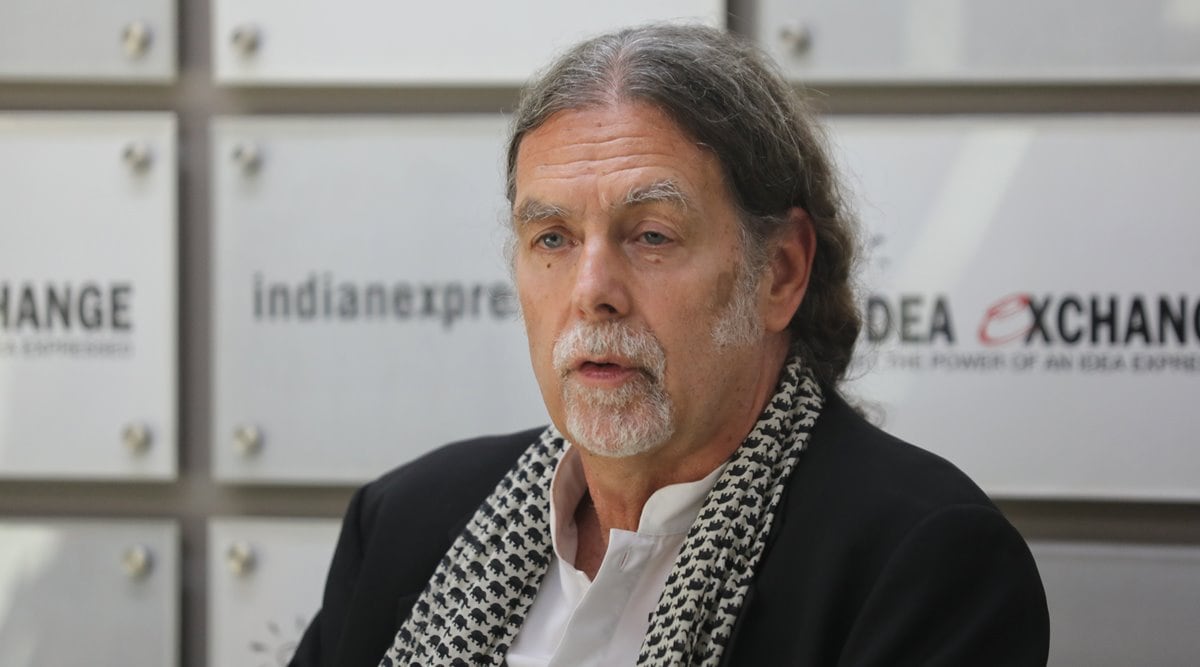
The Russian invasion of Ukraine came as a surprise as “nobody would have thought that President Putin would brutally attack his neighbours. If one is to call a spade a spade, he lied to us, to everyone,” German Ambassador to India Walter J Lindner told The Indian Express Friday.
🗞️ Subscribe Now: Get Express Premium to access the best Election reporting and analysis 🗞️
All countries should realise, he added, that there is “more at stake than just bilateral and emotional relations with Russia” because if Moscow’s aggression against Ukraine sets a precedent, “any country could be under the same threat.”
Qualifying his remarks saying he would not like to comment on India’s position on the matter, Lindner said: “There is a powerful nation with a strong army which was not under threat, nobody was attacking it and the leader of this nation decides my weaker neighbour has no right to exist because this nation belongs to us. So let’s create some pretext and invade, change the borders, violate the sovereignty and integrity just because we can, because we are stronger. We don’t care about UN charter, bilateral agreements.”
“If this sets a precedent, any country could be under the same threat and most of the countries in the world have a strong neighbour and there are a lot of border disputes around the globe and I think, since decades, we have agreed in the United Nations and in different regional fora that peaceful solutions of disputes is the thing to do,” said Lindner, who took over as Germany’s envoy to India in April 2019, said. He was speaking at The Indian Express’s Idea Exchange (a detailed transcript will be published March 7).
So far, India has abstained on two resolutions on Ukraine in the Security Council and one in the 193-member General Assembly. On Friday, India also abstained in a vote in the UN Human Rights Council that decided to set up an independent international commission of inquiry as a consequence of Russia’s aggression against Ukraine.
Significantly, Germany, in a departure from its cautious approach on display even during Moscow’s annexation of Crimea, has sharply reversed its stand.
On February 26, Germany announced it will supply arms to Ukraine, with German chancellor Olaf Scholz underlining that “the Russian invasion of Ukraine marks a turning point.”
Explaining this shift, Lindner said: “Our experience with a brutal Nazi dictatorship, misuse of military, misuse of weapons, we had a very reluctant approach towards arms exports because we know how arms can be misused… We have decided to increase our military budget by over 2 per cent. It was a decision taken with consensus. We never exported weapons, we always said no. But we have said it in the UN and elsewhere that democracy has its price and we are willing to pay it, which means inflation might go up, prices might go up. But you cannot get freedom and democracy for nothing…Putin has opened our eyes that to keep peace, (there) might have a price so we will do that,” Lindner said, describing Russian aggression as “Putin’s war”.
The Russian invasion of Ukraine came as a surprise as “nobody would have thought that President Putin would brutally attack his neighbours. If one is to call a spade a spade, he lied to us, to everyone,” German Ambassador to India Walter J Lindner told The Indian Express Friday. 🗞️ Subscribe Now: Get Express Premium to access the best Election reporting and analysis 🗞️ All countries should realise, he added, that there is “more at stake than just bilateral and emotional relations with Russia” because if Moscow’s aggression against Ukraine sets a precedent, “any country could be under the same threat.” Qualifying his remarks saying he would not like to comment on India’s position on the matter, Lindner said: “There is a powerful nation with a strong army which was not under threat, nobody was attacking it and the leader of this nation decides my weaker neighbour has no right to exist because this nation belongs to us. So let’s create some pretext and invade, change the borders, violate the sovereignty and integrity just because we can, because we are stronger. We don’t care about UN charter, bilateral agreements.” “If this sets a precedent, any country could be under the same threat and most of the countries in the world have a strong neighbour and there are a lot of border disputes around the globe and I think, since decades, we have agreed in the United Nations and in different regional fora that peaceful solutions of disputes is the thing to do,” said Lindner, who took over as Germany’s envoy to India in April 2019, said. He was speaking at The Indian Express’s Idea Exchange (a detailed transcript will be published March 7). So far, India has abstained on two resolutions on Ukraine in the Security Council and one in the 193-member General Assembly. On Friday, India also abstained in a vote in the UN Human Rights Council that decided to set up an independent international commission of inquiry as a consequence of Russia’s aggression against Ukraine. Significantly, Germany, in a departure from its cautious approach on display even during Moscow’s annexation of Crimea, has sharply reversed its stand. On February 26, Germany announced it will supply arms to Ukraine, with German chancellor Olaf Scholz underlining that “the Russian invasion of Ukraine marks a turning point.” Explaining this shift, Lindner said: “Our experience with a brutal Nazi dictatorship, misuse of military, misuse of weapons, we had a very reluctant approach towards arms exports because we know how arms can be misused… We have decided to increase our military budget by over 2 per cent. It was a decision taken with consensus. We never exported weapons, we always said no. But we have said it in the UN and elsewhere that democracy has its price and we are willing to pay it, which means inflation might go up, prices might go up. But you cannot get freedom and democracy for nothing…Putin has opened our eyes that to keep peace, (there) might have a price so we will do that,” Lindner said, describing Russian aggression as “Putin’s war”.