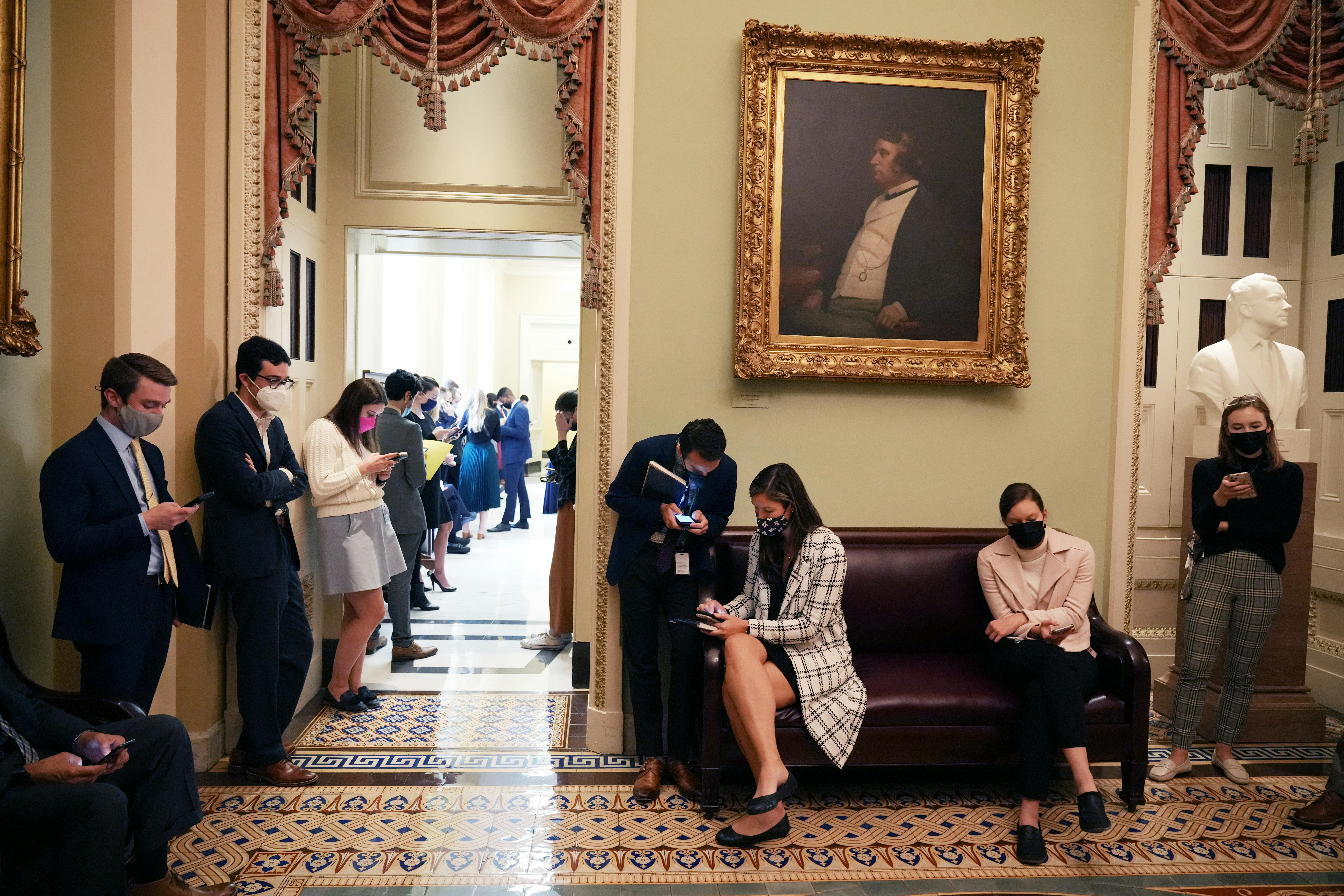
Last Thursday night in the Navy Yard neighborhood of
Washington, D.C., a few dozen Hill staffers, mostly in their twenties, wearing
their finest business casual, stood around chatting about who worked for which
lawmaker and complaining about niche annoyances like the timing of floor votes.
When not running interference for their bosses, these indispensables of the
nation’s capital can be found at networking events disguised as parties, like
this gathering, or huddled around discounted beers at the cheapest happy hours
throughout the city.
They’d gathered in real life that night to mark the launch
of a new app—CNCT, pronounced “connect”—a social network that is designed to
help them bond digitally, a modernized “Hill coffee” that will be exclusively
available to people who work on Capitol Hill. Even though the party started at eight, people trickled in throughout the hour with many coming directly from the
Capitol. It’s a well-known joke inside the Beltway bubble that Hill staffers
are overworked and underpaid—but it’s recently come to light just how overworked and underpaid.
During the pandemic, opportunities to commiserate over those
shared woes diminished. No one understands what it’s like to work on the Hill
the way a staffer does, but like individuals in public and private sector jobs
across the country, they were isolated. David Tennent, who until recently was digital
director for Republican Representative Guy Reschenthaler, spent his pandemic lockdown
days working from home but brainstorming how to make up for the lack of networking.
Two years later, his idea is now a fully fledged app that he hopes will revamp
the way staffers communicate with each other.
Tennent isn’t selling CNCT directly as part of a new effort
to boost working conditions in the House and Senate. Instead, he harkens back
to ideals of lost bipartisanship. He told me that during his time on the Hill, he found that only talking to colleagues within his office or even within his
political party made it “really easy to dehumanize [the other side] and just
see them as the enemy.” But he said he’s learned that he has a lot more in
common with people of the opposite party than he originally thought. “We might
have completely different political views, but 95 percent of the issues we
actually agree on,” Tennent said.
It remains to be seen whether the
app will eventually help a GOP legislative aide bond with a Democratic comms
director, but there’s promise. At the launch party on Thursday, the crowd at
least connected over shared bottles of wine and communal cases of spiked
seltzers—BYOB, of course. But when I chatted with the guests on that
rooftop launch, one of the most common uniting issues across party lines was
the treatment of congressional staff.
One junior staffer I spoke to at the party—who requested
anonymity to speak freely about his job conditions—described working on the Hill as a “grind.” He explained that, especially as a lower-level staffer, you
often find yourself doing multiple jobs and that the tireless work and long
hours are part of why Hill staffers are able to bond so easily, even if they
might not agree on what public policy they’re implementing. He added that when Hill staffers connect, it is inevitable that the conversation will turn to how
each office runs—often comparing notes on how offices are structured.
In February, Capitol Hill staff gossip was suddenly consumed
by a newly launched Instagram account called, “Dear White Staffers.” It quickly
became a popular platform where staffers of color could air their grievances
and legitimize that the citywide joke on their working conditions is not a joke
at all. The account was originally meme-centric content but evolved into a
space where people could anonymously submit their experiences, both good and
bad. Much of what they post recounts borderline abusive conditions staffers
allege they face, in addition to their exploitative wages.
Stories shared on the app—all anonymous—include instances of
emotional and physical abuse, including multiple examples of staffers alleging
they have been screamed at and even had things thrown at them. Dear White
Staffers also shares counter stories to these allegations that in some cases
defend certain lawmakers.
Around the same time Dear White Staffers gained popularity,
a group of Hill staffers called the Congressional Workers Union announced
efforts to try to unionize all congressional employees. In its launch
statement, the CWU said via Twitter in February, “after more than a
year of organizing as a volunteer group of congressional staff, we are proud to
publicly announce our efforts to unionize the personal offices and committees
of Congress, in solidarity with our fellow workers across the United States and
the world.”
The statement cited data from a survey that the Congressional Progressive
Staff Association, a group formed last year dedicated to encouraging
activists to pursue careers on the Hill, conducted in early 2022. The CPSA sent
out a survey about working conditions on Capitol Hill through congressional
listservs. It received over 500 completed surveys, with a majority of
participants from nonmanagement roles. According to the results, 91 percent of
all respondents reported wanting “more protections to give them a voice at
work.” They also found that half of nonmanagerial staff respondents reported
that they struggle to pay their bills.
Democratic Representative Andy Levin of Michigan proposed a resolution in the House last month that would
give Hill employees the option to form unions. “We must allow staff to exercise their protected labor
rights without fear of retaliation,” Levin said in a press release earlier
this month following a House Administration hearing on the resolution. “Congressional staff deserve, at
long last, much-needed protections as they consider forming and joining unions
here in Congress.”
Advocates
for unionization on Capitol Hill are becoming more vocal. Despite the recent
influx of support, however, many staffers I spoke with for this article still
requested to remain anonymous for the sake of their jobs. “When I think
of ways things can progress for Hill staff,” said a junior staffer for
democratic leadership, “I think at least from my view, it’s increased payment,
and I think I’m lucky enough to be happy with where I am, but I shouldn’t have
to just be lucky, it should be standard.”
During the House hearing, the issue of allowing
congressional staff to unionize fell mostly along party lines, with the Democrats
present supportive and Republicans skeptical. Ranking member Rodney Davis of Illinois
said that he generally supports unions, but in the case of congressional staff,
a union would be “unworkable” and “impractical.” Reporter Jim Saska, who
covered the hearing for Roll
Call, noted that “many [Democratic lawmakers] have yet to signal their support for staff
unionization.”
The democratic staffer I spoke with said they are
“tentatively supportive” of the unionization efforts but want to know more
about how it would function before being fully on board. “How unions operate in
places outside the government sphere, I’m very supportive of … but I kind of
want to know more about how it would work,” they added, “what the structure of
it would be, because at the Hill, every office is kind of like its own company,
it’s such a unique setup.”
It is unclear how many staffers are involved in the CWU and
what party they are from, but their desire to improve working conditions is
vehement. They have garnered over 4,000 followers on Twitter in their first
month through consistent messages and statements.
The CWU is not associated with Dear White Staffers, CPSA, or
CNCT. However, independently they have each provided a voice for staffers that
did not previously exist. Whether publicly through social media or via one-on-one
conversations in the case of CNCT, there are now several new vehicles for staffers
to communicate.
“I’m glad to see staffers standing up against the old and
antiquated systems that have been tradition on the Hill for far too long,” said
Tennent. “While we aren’t directly involved in this movement, we’re seeing where
staffers are standing up and demanding a seat at the table. It’s cool to see a
variety of groups on the Hill taking it upon themselves to improve life as a Hill staffer.” When I asked Tennent whether he’s supportive of the union
drive, he declined to answer directly but said he thinks staffers deserve
better regardless.
Through Tennent’s app—which launches March 18 and is
initially only open to people who sign up using their house.gov or senate.gov
email address—users can schedule coffees, join interest groups, find out about
job openings, and create networking events like the party held for CNCT’s
launch. “One of the reasons why I started CNCT was to upgrade the antiquated
systems that I saw staffers using in order to connect and meet new people in
order to build a fulfilling life in D.C.,” Tennent told me during the launch
party.
Having a “fulfilling” existence where work and life are in
balance can often feel impossible, especially early in your career, according to
several of the people I spoke to at that rooftop launch. They noted that
improved working conditions and pay increases would help in achieving that
balance.
One person, a committee staffer, who requested to remain
anonymous, argued for the overall benefits of bettering life for staff. “It’s
important to lower the financial bar to work on Capitol Hill so that people
from all different backgrounds can come and have these experiences,” they said.
“And that’s valuable, to have representation from everywhere in the U.S., because
staff influences the policy.”
Last Thursday night in the Navy Yard neighborhood of Washington, D.C., a few dozen Hill staffers, mostly in their twenties, wearing their finest business casual, stood around chatting about who worked for which lawmaker and complaining about niche annoyances like the timing of floor votes. When not running interference for their bosses, these indispensables of the nation’s capital can be found at networking events disguised as parties, like this gathering, or huddled around discounted beers at the cheapest happy hours throughout the city.They’d gathered in real life that night to mark the launch of a new app—CNCT, pronounced “connect”—a social network that is designed to help them bond digitally, a modernized “Hill coffee” that will be exclusively available to people who work on Capitol Hill. Even though the party started at eight, people trickled in throughout the hour with many coming directly from the Capitol. It’s a well-known joke inside the Beltway bubble that Hill staffers are overworked and underpaid—but it’s recently come to light just how overworked and underpaid.During the pandemic, opportunities to commiserate over those shared woes diminished. No one understands what it’s like to work on the Hill the way a staffer does, but like individuals in public and private sector jobs across the country, they were isolated. David Tennent, who until recently was digital director for Republican Representative Guy Reschenthaler, spent his pandemic lockdown days working from home but brainstorming how to make up for the lack of networking. Two years later, his idea is now a fully fledged app that he hopes will revamp the way staffers communicate with each other.Tennent isn’t selling CNCT directly as part of a new effort to boost working conditions in the House and Senate. Instead, he harkens back to ideals of lost bipartisanship. He told me that during his time on the Hill, he found that only talking to colleagues within his office or even within his political party made it “really easy to dehumanize [the other side] and just see them as the enemy.” But he said he’s learned that he has a lot more in common with people of the opposite party than he originally thought. “We might have completely different political views, but 95 percent of the issues we actually agree on,” Tennent said.It remains to be seen whether the app will eventually help a GOP legislative aide bond with a Democratic comms director, but there’s promise. At the launch party on Thursday, the crowd at least connected over shared bottles of wine and communal cases of spiked seltzers—BYOB, of course. But when I chatted with the guests on that rooftop launch, one of the most common uniting issues across party lines was the treatment of congressional staff.One junior staffer I spoke to at the party—who requested anonymity to speak freely about his job conditions—described working on the Hill as a “grind.” He explained that, especially as a lower-level staffer, you often find yourself doing multiple jobs and that the tireless work and long hours are part of why Hill staffers are able to bond so easily, even if they might not agree on what public policy they’re implementing. He added that when Hill staffers connect, it is inevitable that the conversation will turn to how each office runs—often comparing notes on how offices are structured.In February, Capitol Hill staff gossip was suddenly consumed by a newly launched Instagram account called, “Dear White Staffers.” It quickly became a popular platform where staffers of color could air their grievances and legitimize that the citywide joke on their working conditions is not a joke at all. The account was originally meme-centric content but evolved into a space where people could anonymously submit their experiences, both good and bad. Much of what they post recounts borderline abusive conditions staffers allege they face, in addition to their exploitative wages.Stories shared on the app—all anonymous—include instances of emotional and physical abuse, including multiple examples of staffers alleging they have been screamed at and even had things thrown at them. Dear White Staffers also shares counter stories to these allegations that in some cases defend certain lawmakers.Around the same time Dear White Staffers gained popularity, a group of Hill staffers called the Congressional Workers Union announced efforts to try to unionize all congressional employees. In its launch statement, the CWU said via Twitter in February, “after more than a year of organizing as a volunteer group of congressional staff, we are proud to publicly announce our efforts to unionize the personal offices and committees of Congress, in solidarity with our fellow workers across the United States and the world.”The statement cited data from a survey that the Congressional Progressive Staff Association, a group formed last year dedicated to encouraging activists to pursue careers on the Hill, conducted in early 2022. The CPSA sent out a survey about working conditions on Capitol Hill through congressional listservs. It received over 500 completed surveys, with a majority of participants from nonmanagement roles. According to the results, 91 percent of all respondents reported wanting “more protections to give them a voice at work.” They also found that half of nonmanagerial staff respondents reported that they struggle to pay their bills. Democratic Representative Andy Levin of Michigan proposed a resolution in the House last month that would give Hill employees the option to form unions. “We must allow staff to exercise their protected labor rights without fear of retaliation,” Levin said in a press release earlier this month following a House Administration hearing on the resolution. “Congressional staff deserve, at long last, much-needed protections as they consider forming and joining unions here in Congress.”Advocates for unionization on Capitol Hill are becoming more vocal. Despite the recent influx of support, however, many staffers I spoke with for this article still requested to remain anonymous for the sake of their jobs. “When I think of ways things can progress for Hill staff,” said a junior staffer for democratic leadership, “I think at least from my view, it’s increased payment, and I think I’m lucky enough to be happy with where I am, but I shouldn’t have to just be lucky, it should be standard.”During the House hearing, the issue of allowing congressional staff to unionize fell mostly along party lines, with the Democrats present supportive and Republicans skeptical. Ranking member Rodney Davis of Illinois said that he generally supports unions, but in the case of congressional staff, a union would be “unworkable” and “impractical.” Reporter Jim Saska, who covered the hearing for Roll Call, noted that “many [Democratic lawmakers] have yet to signal their support for staff unionization.”The democratic staffer I spoke with said they are “tentatively supportive” of the unionization efforts but want to know more about how it would function before being fully on board. “How unions operate in places outside the government sphere, I’m very supportive of … but I kind of want to know more about how it would work,” they added, “what the structure of it would be, because at the Hill, every office is kind of like its own company, it’s such a unique setup.”It is unclear how many staffers are involved in the CWU and what party they are from, but their desire to improve working conditions is vehement. They have garnered over 4,000 followers on Twitter in their first month through consistent messages and statements.The CWU is not associated with Dear White Staffers, CPSA, or CNCT. However, independently they have each provided a voice for staffers that did not previously exist. Whether publicly through social media or via one-on-one conversations in the case of CNCT, there are now several new vehicles for staffers to communicate. “I’m glad to see staffers standing up against the old and antiquated systems that have been tradition on the Hill for far too long,” said Tennent. “While we aren’t directly involved in this movement, we’re seeing where staffers are standing up and demanding a seat at the table. It’s cool to see a variety of groups on the Hill taking it upon themselves to improve life as a Hill staffer.” When I asked Tennent whether he’s supportive of the union drive, he declined to answer directly but said he thinks staffers deserve better regardless.Through Tennent’s app—which launches March 18 and is initially only open to people who sign up using their house.gov or senate.gov email address—users can schedule coffees, join interest groups, find out about job openings, and create networking events like the party held for CNCT’s launch. “One of the reasons why I started CNCT was to upgrade the antiquated systems that I saw staffers using in order to connect and meet new people in order to build a fulfilling life in D.C.,” Tennent told me during the launch party.Having a “fulfilling” existence where work and life are in balance can often feel impossible, especially early in your career, according to several of the people I spoke to at that rooftop launch. They noted that improved working conditions and pay increases would help in achieving that balance. One person, a committee staffer, who requested to remain anonymous, argued for the overall benefits of bettering life for staff. “It’s important to lower the financial bar to work on Capitol Hill so that people from all different backgrounds can come and have these experiences,” they said. “And that’s valuable, to have representation from everywhere in the U.S., because staff influences the policy.”