
Show key events only
09:29
VP Harris flies into middle of Nato debacle over providing fighter jets to Ukraine

Joan E Greve
Kamala Harris’ trip to eastern Europe comes as the US and Poland have publicly clashed over how to handle the transfer of fighter jets to Ukrainian forces.
Poland’s foreign minister announced Tuesday that the country was “ready to deploy – immediately and free of charge – all their Russian-made MiG-29 jets to the [US] Ramstein air base and place them at the disposal of the government of the United States of America”.
It was originally expected that the US would receive the planes and then donate them to Ukraine, but the Pentagon released a statement hours after Poland’s announcement saying that was not a feasible plan.
“The prospect of fighter jets ‘at the disposal of the Government of the United States of America’ departing from a US/Nato base in Germany to fly into airspace that is contested with Russia over Ukraine raises serious concerns for the entire Nato alliance,” said John Kirby, the Pentagon press secretary.
“We will continue to consult with Poland and our other Nato allies about this issue and the difficult logistical challenges it presents, but we do not believe Poland’s proposal is a tenable one.”
A senior administration official said Tuesday night that the White House has been in consistent communication with the Polish government about how to best provide security assistance to Ukraine.
“That’s a dialogue that absolutely will continue up to and as part of the vice-president’s trip,” the official said. “This is a key priority for us and for all of our Nato allies, and so we expect that we will continue talking about how to achieve this really important objective.”
Ramstein air base in south-western Germany is headquarters for the US air forces in Europe and Nato allied air command.
Updated
11:47
Minneapolis failed to follow emergency protocols during protests, riots in 2020 – official report
Minneapolis mayor Jacob Frey failed to implement the city’s emergency protocols when responding to protests and riots that erupted across Minneapolis after Black resident George Floyd’s horrific, prolonged murder by a white police officer, according to a long-anticipated report.

Mother and daughter Brittany and Brooklyn Elmore pose in Houston, Texas, for a portrait in front of a mural of George Floyd ahead of the anniversary last year of Floyd’s death. Floyd had moved from Texas to Minnesota before his death. Photograph: Callaghan O’Hare/Reuters
The 86-page report by Maryland-based risk management firm Hillard Heintze, whose research staff includes former law enforcement officers, details a breakdown in communications and planning that left residents feeling abandoned and city employees — including police — confused about who was in charge, the Star Tribune reports.
Former officer Derek Chauvin was convicted last year of murdering Floyd in May, 2020, and sentenced to more than 22 years in prison. He later pleaded guilty to federal hate crimes.
Three former, more junior officers, who also played a part in the killing of Floyd were found guilty last month of federal civil rights crimes. Their state trial in which they are accused of aiding and abetting Floyd’s murder is ahead.
Floyd’s brother, Philonise Floyd, called the verdicts “accountability”, but added: “There can never be justice because I can never get George back.”
Minneapolis, and its twin city and Minnesota state capital St Paul, erupted in protest after Floyd was killed, which turned into a massive civil rights uprising across the US and internationally. It was deemed the biggest uprising in the US since the civil rights movement of the 1960s and represented a massive revival of the Black Lives Matter movement against racist police brutality and embedded racism in America’s systems and society.
But protests in the spring of 2020 in Minneapolis turned into riots at the fringes and chaos and violence was thrust upon neighborhoods. Now an official report is out.
The Minneapolis Star Tribune reports:
The report paints a damning picture of the 10 days in May 2020 that continue to traumatize many residents and employees nearly two years later: Some first responders, receiving little guidance from supervisors, traveled blindly into dangerous situations. Police made inconsistent decisions about when to use controversial munitions on crowds. Neighbors and business owners, frustrated by a lack of communication from city leaders, banded together to protect their homes and businesses.
Minneapolis has an emergency operations plan that is “well written, comprehensive and consistent with nationally recognized practices,” the report said. But, it said, the mayor did not “ensure the appropriate implementation” of that plan, hampering the city’s response.
“Even though the level of protest and violence was unprecedented, better planning, organization, communication and adherence to command-and-control principles by the MPD [Minneapolis Police Department] and city officials would have led to a better response,” the report said.
Frey said in a statement Tuesday night that he has asked city staff to create a plan for implementing the report’s roughly two dozen recommendations. The report suggests a range of changes aimed at strengthening and practicing emergency protocols proactively, improving communications among city employees, boosting police training on controversial crowd control tactics and improving employees’ wellness programs.
You can read the rest of that report here.
A look back to Floyd’s funeral:
11:22
At the US state department, we are awaiting a press conference between US secretary of state Antony Blinken and his UK counterpart, British foreign secretary Liz Truss.
There is a live feed at the top of this blog, where we see a podium for each diplomat set up in front of the stars and stripes and the union jack as they prepare to emerge from the meeting they’ve been holding for the last hour-plus.
Friendly reminder: if you prefer our round-the-clock, global Ukraine crisis live blog with all the details we can glean about what is going on in this horrible war, following the invasion by Russia, please click here.
This blog is committed to bringing you more of the US-facing news involving Ukraine, as well as US domestic news.
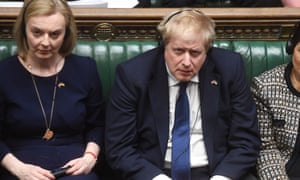
Liz Truss and Britain’s prime minister, Boris Johnson, in the House of Commons, Westminster, London. Photograph: Jessica Taylor/UK PARLIAMENT/AFP/Getty Images
11:13

Patrick Wintour
Clash between Poland and US over MiG-29s reveals tensions in escalating war.
That’s the Guardian’s headline on this analysis piece from our diplomatic editor Patrick Wintour, which notes that the public spat over fighter planes begged for by Ukraine is a setback in Nato unity.
And the upshot of this mini-debacle is that Russia retains air superiority.
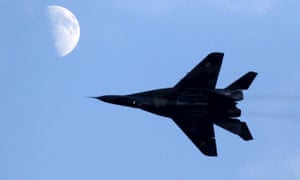
Polish Air Force MiG-29. Photograph: Kacper Pempel/Reuters
Patrick writes: The buck-passing between Poland and the US over the possible use of elderly MiG-29s to hit Russian forces inside Ukraine is one of the west’s few diplomatic failures of the past month. It also raises questions about how far European countries are prepared to escalate militarily before they believe they will touch a dangerous Russian tripwire.
The US and Europe have worked hard to keep their differences over sanctions and oil embargos to a public minimum, and tried to accommodate each other’s national interests. So it was striking on Tuesday when first the Pentagon described a Polish offer to send planes to the US airbase in Ramstein as “untenable”, and then the deputy US secretary of state said the US had not been consulted about the plan.
Part of the problem was that the Polish proposal was subtly but critically different to a scheme that had previously been discussed in private. Against the backdrop of highly charged diplomatic tensions, presentation matters.
In essence, Poland said it would cooperate in strengthening the Ukrainian air force so long as this would be seen in Moscow as a US, Nato or EU scheme but not a Polish one.
In its original, US-conceived iteration, the proposal was a trilateral deal whereby Poland would hand over the MiGs to Ukrainian pilots to fly into their homeland, and the US would then provide some substitute planes. Boris Johnson, an enthusiast, described the plan as “rent a MiG”.
That proposal, arguably, was not qualitatively different to Nato members providing Ukraine with Javelin anti-tank missiles. In return, Poland would eventually fill the hole in its air force with 28 F-16s being provided by the US.
But under private pressure from the US, Poland felt the plan unduly exposed its citizens to Putin’s ire.
So instead, in a game of diplomatic pass the parcel, Poland tweaked the proposals so the planes would be sent free of charge to the US airbase in Ramstein, Germany, rather than being flown out of Poland into Ukraine. The move would literally take Poland out of the line of Russia’s fire since the plan could be labelled as that of the US, Nato or the EU.
Poland also suggested other frontline Nato countries with MiG planes should match its plan, a proposal directed at Slovakia and Romania. If executed it would mean Ukraine had 70 extra planes at its disposal.
The Pentagon’s response – “it is simply not clear to us that there is a tangible justification for this” – was swift. Passing the parcel back, it said any decision to hand over planes ultimately rested with the Polish government, although it did not kill off the proposal altogether. The rest of the piece is here.
11:03
Kamala Harris’s trip to eastern Europe today is a crucial test for the vice president, her first visit to the continent after a sticky first year in the role held by Joe Biden for two terms as Barack Obama’s right-hand man.

Covid not over. Kamala Harris arrives to board Air Force Two at Joint Base Andrews in Maryland this morning, en route to Poland. Photograph: Saul Loeb/AFP/Getty Images
Harris, formerly a Democratic US Senator and the attorney general of California, has been very much in the spotlight since being chosen by Biden to be his veep and becoming the first woman and first American of color in that vital but fraught political role.
Unfortunately for Harris, this planned trip suddenly became a lot more tricky in the last three days after talk at the weekend that Poland would give second-hand fighter jets to the Ukrainian military (whose pilots are trained on such Russian-built models such as MiG and Sukhoi) and Poland’s supplies could be “back-filled” by the US with some of its fighter jets.
But that idea descended into a debacle yesterday, of which more in a moment. So Harris was flying into an already-tense scenario, with the war in Ukraine on Nato-member Poland’s eastern flank ever intensifying, but one that could also be a good opportunity for her to acquire statesmanlike kudos.
Now she’ll be landing later today in the middle of a massive diplomatic mess. Among Harris’s roles in the US, she is supposed to be steering voting rights legislation to fruition – which has stalled in the Senate and produced almost unlimited frustration from many of the Biden-Harris administration’s most important voters.
And she is charged with dealing with aspects of the US-Mexico border – specifically with the root causes of migration that drive economic, political, domestic violence, gang violence and climate migrants to seek refuge and opportunity in the US. But border policies are a horrible mess, she tends to take heat and often does not help herself by coming across as defensive when asked questions about tricky topics.
Here is the latest Guardian US special report on the border from our Nina Lakhani.
10:31
Blinken, Truss meet in Washington
Secretary of State Antony Blinken is back in the US after being in Poland and Moldova at the weekend, where he saw the streams of refugees coming across the border from the war to the east, and he stepped onto Ukrainian soil briefly with Ukraine’s foreign minister.

US Secretary of State Antony Blinken (C) disembarks his plane at Paris-Le Bourget Aiport, north of Paris as he arrives for his visit to Paris yesterday. Photograph: AFP/Getty Images
He was in Paris yesterday but right now, Blinken is meeting in Washington with his UK counterpart, British foreign secretary Liz Truss.
The two are expected to hold a press conference about 45 minutes from now (11.15am ET/4.15pm GMT) at the State Department.
They are primarily talking about what more can be done to assist Ukraine (without risking a Russia-Nato war) and how Britain, Europe and the west can reduce their dependency on the Russian energy sector, especially in the short term.
The US and the UK have announced the suspension of imports of Russian oil and gas.
“The Ukraine crisis is a wake-up call for free democracies,” Truss said in a statement.
“I am in the US to talk about what more we can do to deter hostile state actors, reduce strategic dependency on Russian energy – and authoritarian states more broadly – and build stronger economic and security alliances around the world.”
Truss will also meet with US national security adviser Jake Sullivan.
Updated
09:50
Joan E Greve
Vice president Harris took off from the US this morning in Air Force Two en route to Poland. She is on a trip to the capital, Warsaw, and then on to the Romanian capital, Bucharest, to meet with allied leaders and discuss the war in Ukraine.
“This trip to the eastern flank [of Nato members] is further support to our allies and is also an extremely important opportunity to collaborate with them on next steps in responding to Russian aggression,” a senior administration official said Tuesday night.
The official said Harris will meet Thursday with the Polish president, Andrzej Duda, and the country’s prime minister, Mateusz Morawiecki, in Warsaw. Harris will also sit down with the Canadian prime minister, Justin Trudueau, who will be in Poland at the same time.
In Bucharest, Harris will meet with the Romanian president, Klaus Iohannis, as well as embassy staffers.
In addition to her meetings with allied leaders, Harris will have “an opportunity to engage with people who have fled the violence in Ukraine” while in Warsaw, the official said.
More than two million people have now fled Ukraine since the Russian invasion, and many of those refugees have escaped to neighboring countries in eastern Europe.
Polish officials have said that more than 100,000 people from Ukraine are arriving in their country each day.
Harris’s trip was planned before the confusion unfolded over whether and how Poland would supply fighter jets to Ukraine.
09:29
VP Harris flies into middle of Nato debacle over providing fighter jets to Ukraine
Joan E Greve
Kamala Harris’ trip to eastern Europe comes as the US and Poland have publicly clashed over how to handle the transfer of fighter jets to Ukrainian forces.
Poland’s foreign minister announced Tuesday that the country was “ready to deploy – immediately and free of charge – all their Russian-made MiG-29 jets to the [US] Ramstein air base and place them at the disposal of the government of the United States of America”.
It was originally expected that the US would receive the planes and then donate them to Ukraine, but the Pentagon released a statement hours after Poland’s announcement saying that was not a feasible plan.
“The prospect of fighter jets ‘at the disposal of the Government of the United States of America’ departing from a US/Nato base in Germany to fly into airspace that is contested with Russia over Ukraine raises serious concerns for the entire Nato alliance,” said John Kirby, the Pentagon press secretary.
“We will continue to consult with Poland and our other Nato allies about this issue and the difficult logistical challenges it presents, but we do not believe Poland’s proposal is a tenable one.”
A senior administration official said Tuesday night that the White House has been in consistent communication with the Polish government about how to best provide security assistance to Ukraine.
“That’s a dialogue that absolutely will continue up to and as part of the vice-president’s trip,” the official said. “This is a key priority for us and for all of our Nato allies, and so we expect that we will continue talking about how to achieve this really important objective.”
Ramstein air base in south-western Germany is headquarters for the US air forces in Europe and Nato allied air command.
Updated
09:20
Harris flies to Poland amid confusion over foreign fighter jets for Ukraine
Good morning to the readers of our US politics live blog. There’s a busy day ahead and we’ll have all the developments in American politics news here, including much related to Ukraine, while the Guardian’s global, round-the-clock blogging of the Russian invasion of Ukraine can be read separately here.
Here’s what’s happening so far today:
- US vice-president Kamala Harris is on her way to Poland right now, on a high-profile trip amid the war in Ukraine. She will visit Warsaw and also Bucharest, Romania, to meet with allied leaders and discuss the crisis, including the issue of Poland’s suggestions that it supply the Ukrainian military with second-hand, Russian-designed fighter jets – but via the US, which has raised fears once again about the US being drawn into what could be interpreted in Moscow as military action with Russia.
- The US House of Representatives is considering a large spending bill that includes almost $14bn in emergency aid for Ukraine. It’s part of a $1.5tr spending bill finalized overnight, which the House will take up today.
- A report finds that the authorities in Minneapolis failed to respond correctly to the mass protests, with rioting involved, that erupted in the Minnesota city in late spring 2020 after a white police officer murdered Black resident George Floyd.
- Donald Trump was scared of Vladimir Putin but nevertheless admired the Russian autocratic president’s capacity to kill whomever he wanted, according to former White House press sec during the Republican president’s single term, Stephanie Grisham.
Show key events only 09:29 VP Harris flies into middle of Nato debacle over providing fighter jets to Ukraine Joan E Greve Kamala Harris’ trip to eastern Europe comes as the US and Poland have publicly clashed over how to handle the transfer of fighter jets to Ukrainian forces. Poland’s foreign minister announced Tuesday that the country was “ready to deploy – immediately and free of charge – all their Russian-made MiG-29 jets to the [US] Ramstein air base and place them at the disposal of the government of the United States of America”. It was originally expected that the US would receive the planes and then donate them to Ukraine, but the Pentagon released a statement hours after Poland’s announcement saying that was not a feasible plan. “The prospect of fighter jets ‘at the disposal of the Government of the United States of America’ departing from a US/Nato base in Germany to fly into airspace that is contested with Russia over Ukraine raises serious concerns for the entire Nato alliance,” said John Kirby, the Pentagon press secretary. “We will continue to consult with Poland and our other Nato allies about this issue and the difficult logistical challenges it presents, but we do not believe Poland’s proposal is a tenable one.” A senior administration official said Tuesday night that the White House has been in consistent communication with the Polish government about how to best provide security assistance to Ukraine. “That’s a dialogue that absolutely will continue up to and as part of the vice-president’s trip,” the official said. “This is a key priority for us and for all of our Nato allies, and so we expect that we will continue talking about how to achieve this really important objective.” Ramstein air base in south-western Germany is headquarters for the US air forces in Europe and Nato allied air command. Updated at 9.51am EST 11.47am EST 11:47 Minneapolis failed to follow emergency protocols during protests, riots in 2020 – official report Minneapolis mayor Jacob Frey failed to implement the city’s emergency protocols when responding to protests and riots that erupted across Minneapolis after Black resident George Floyd’s horrific, prolonged murder by a white police officer, according to a long-anticipated report. Mother and daughter Brittany and Brooklyn Elmore pose in Houston, Texas, for a portrait in front of a mural of George Floyd ahead of the anniversary last year of Floyd’s death. Floyd had moved from Texas to Minnesota before his death. Photograph: Callaghan O’Hare/Reuters The 86-page report by Maryland-based risk management firm Hillard Heintze, whose research staff includes former law enforcement officers, details a breakdown in communications and planning that left residents feeling abandoned and city employees — including police — confused about who was in charge, the Star Tribune reports. Former officer Derek Chauvin was convicted last year of murdering Floyd in May, 2020, and sentenced to more than 22 years in prison. He later pleaded guilty to federal hate crimes. Three former, more junior officers, who also played a part in the killing of Floyd were found guilty last month of federal civil rights crimes. Their state trial in which they are accused of aiding and abetting Floyd’s murder is ahead. Floyd’s brother, Philonise Floyd, called the verdicts “accountability”, but added: “There can never be justice because I can never get George back.” Minneapolis, and its twin city and Minnesota state capital St Paul, erupted in protest after Floyd was killed, which turned into a massive civil rights uprising across the US and internationally. It was deemed the biggest uprising in the US since the civil rights movement of the 1960s and represented a massive revival of the Black Lives Matter movement against racist police brutality and embedded racism in America’s systems and society. But protests in the spring of 2020 in Minneapolis turned into riots at the fringes and chaos and violence was thrust upon neighborhoods. Now an official report is out. The Minneapolis Star Tribune reports: The report paints a damning picture of the 10 days in May 2020 that continue to traumatize many residents and employees nearly two years later: Some first responders, receiving little guidance from supervisors, traveled blindly into dangerous situations. Police made inconsistent decisions about when to use controversial munitions on crowds. Neighbors and business owners, frustrated by a lack of communication from city leaders, banded together to protect their homes and businesses. Minneapolis has an emergency operations plan that is “well written, comprehensive and consistent with nationally recognized practices,” the report said. But, it said, the mayor did not “ensure the appropriate implementation” of that plan, hampering the city’s response. “Even though the level of protest and violence was unprecedented, better planning, organization, communication and adherence to command-and-control principles by the MPD [Minneapolis Police Department] and city officials would have led to a better response,” the report said. Frey said in a statement Tuesday night that he has asked city staff to create a plan for implementing the report’s roughly two dozen recommendations. The report suggests a range of changes aimed at strengthening and practicing emergency protocols proactively, improving communications among city employees, boosting police training on controversial crowd control tactics and improving employees’ wellness programs. You can read the rest of that report here. A look back to Floyd’s funeral: 11.22am EST 11:22 At the US state department, we are awaiting a press conference between US secretary of state Antony Blinken and his UK counterpart, British foreign secretary Liz Truss. There is a live feed at the top of this blog, where we see a podium for each diplomat set up in front of the stars and stripes and the union jack as they prepare to emerge from the meeting they’ve been holding for the last hour-plus. Friendly reminder: if you prefer our round-the-clock, global Ukraine crisis live blog with all the details we can glean about what is going on in this horrible war, following the invasion by Russia, please click here. This blog is committed to bringing you more of the US-facing news involving Ukraine, as well as US domestic news. Liz Truss and Britain’s prime minister, Boris Johnson, in the House of Commons, Westminster, London. Photograph: Jessica Taylor/UK PARLIAMENT/AFP/Getty Images 11.13am EST 11:13 Patrick Wintour Clash between Poland and US over MiG-29s reveals tensions in escalating war. That’s the Guardian’s headline on this analysis piece from our diplomatic editor Patrick Wintour, which notes that the public spat over fighter planes begged for by Ukraine is a setback in Nato unity. And the upshot of this mini-debacle is that Russia retains air superiority. Polish Air Force MiG-29. Photograph: Kacper Pempel/Reuters Patrick writes: The buck-passing between Poland and the US over the possible use of elderly MiG-29s to hit Russian forces inside Ukraine is one of the west’s few diplomatic failures of the past month. It also raises questions about how far European countries are prepared to escalate militarily before they believe they will touch a dangerous Russian tripwire. The US and Europe have worked hard to keep their differences over sanctions and oil embargos to a public minimum, and tried to accommodate each other’s national interests. So it was striking on Tuesday when first the Pentagon described a Polish offer to send planes to the US airbase in Ramstein as “untenable”, and then the deputy US secretary of state said the US had not been consulted about the plan. Part of the problem was that the Polish proposal was subtly but critically different to a scheme that had previously been discussed in private. Against the backdrop of highly charged diplomatic tensions, presentation matters. In essence, Poland said it would cooperate in strengthening the Ukrainian air force so long as this would be seen in Moscow as a US, Nato or EU scheme but not a Polish one. In its original, US-conceived iteration, the proposal was a trilateral deal whereby Poland would hand over the MiGs to Ukrainian pilots to fly into their homeland, and the US would then provide some substitute planes. Boris Johnson, an enthusiast, described the plan as “rent a MiG”. That proposal, arguably, was not qualitatively different to Nato members providing Ukraine with Javelin anti-tank missiles. In return, Poland would eventually fill the hole in its air force with 28 F-16s being provided by the US. But under private pressure from the US, Poland felt the plan unduly exposed its citizens to Putin’s ire. So instead, in a game of diplomatic pass the parcel, Poland tweaked the proposals so the planes would be sent free of charge to the US airbase in Ramstein, Germany, rather than being flown out of Poland into Ukraine. The move would literally take Poland out of the line of Russia’s fire since the plan could be labelled as that of the US, Nato or the EU. Poland also suggested other frontline Nato countries with MiG planes should match its plan, a proposal directed at Slovakia and Romania. If executed it would mean Ukraine had 70 extra planes at its disposal. The Pentagon’s response – “it is simply not clear to us that there is a tangible justification for this” – was swift. Passing the parcel back, it said any decision to hand over planes ultimately rested with the Polish government, although it did not kill off the proposal altogether. The rest of the piece is here. 11.03am EST 11:03 Kamala Harris’s trip to eastern Europe today is a crucial test for the vice president, her first visit to the continent after a sticky first year in the role held by Joe Biden for two terms as Barack Obama’s right-hand man. Covid not over. Kamala Harris arrives to board Air Force Two at Joint Base Andrews in Maryland this morning, en route to Poland. Photograph: Saul Loeb/AFP/Getty Images Harris, formerly a Democratic US Senator and the attorney general of California, has been very much in the spotlight since being chosen by Biden to be his veep and becoming the first woman and first American of color in that vital but fraught political role. Unfortunately for Harris, this planned trip suddenly became a lot more tricky in the last three days after talk at the weekend that Poland would give second-hand fighter jets to the Ukrainian military (whose pilots are trained on such Russian-built models such as MiG and Sukhoi) and Poland’s supplies could be “back-filled” by the US with some of its fighter jets. But that idea descended into a debacle yesterday, of which more in a moment. So Harris was flying into an already-tense scenario, with the war in Ukraine on Nato-member Poland’s eastern flank ever intensifying, but one that could also be a good opportunity for her to acquire statesmanlike kudos. Now she’ll be landing later today in the middle of a massive diplomatic mess. Among Harris’s roles in the US, she is supposed to be steering voting rights legislation to fruition – which has stalled in the Senate and produced almost unlimited frustration from many of the Biden-Harris administration’s most important voters. And she is charged with dealing with aspects of the US-Mexico border – specifically with the root causes of migration that drive economic, political, domestic violence, gang violence and climate migrants to seek refuge and opportunity in the US. But border policies are a horrible mess, she tends to take heat and often does not help herself by coming across as defensive when asked questions about tricky topics. Here is the latest Guardian US special report on the border from our Nina Lakhani. 10.31am EST 10:31 Blinken, Truss meet in Washington Secretary of State Antony Blinken is back in the US after being in Poland and Moldova at the weekend, where he saw the streams of refugees coming across the border from the war to the east, and he stepped onto Ukrainian soil briefly with Ukraine’s foreign minister. US Secretary of State Antony Blinken (C) disembarks his plane at Paris-Le Bourget Aiport, north of Paris as he arrives for his visit to Paris yesterday. Photograph: AFP/Getty Images He was in Paris yesterday but right now, Blinken is meeting in Washington with his UK counterpart, British foreign secretary Liz Truss. The two are expected to hold a press conference about 45 minutes from now (11.15am ET/4.15pm GMT) at the State Department. They are primarily talking about what more can be done to assist Ukraine (without risking a Russia-Nato war) and how Britain, Europe and the west can reduce their dependency on the Russian energy sector, especially in the short term. The US and the UK have announced the suspension of imports of Russian oil and gas. “The Ukraine crisis is a wake-up call for free democracies,” Truss said in a statement. “I am in the US to talk about what more we can do to deter hostile state actors, reduce strategic dependency on Russian energy – and authoritarian states more broadly – and build stronger economic and security alliances around the world.” Truss will also meet with US national security adviser Jake Sullivan. Updated at 10.35am EST 9.50am EST 09:50 Joan E Greve Vice president Harris took off from the US this morning in Air Force Two en route to Poland. She is on a trip to the capital, Warsaw, and then on to the Romanian capital, Bucharest, to meet with allied leaders and discuss the war in Ukraine. “This trip to the eastern flank [of Nato members] is further support to our allies and is also an extremely important opportunity to collaborate with them on next steps in responding to Russian aggression,” a senior administration official said Tuesday night. The official said Harris will meet Thursday with the Polish president, Andrzej Duda, and the country’s prime minister, Mateusz Morawiecki, in Warsaw. Harris will also sit down with the Canadian prime minister, Justin Trudueau, who will be in Poland at the same time. In Bucharest, Harris will meet with the Romanian president, Klaus Iohannis, as well as embassy staffers. In addition to her meetings with allied leaders, Harris will have “an opportunity to engage with people who have fled the violence in Ukraine” while in Warsaw, the official said. More than two million people have now fled Ukraine since the Russian invasion, and many of those refugees have escaped to neighboring countries in eastern Europe. Polish officials have said that more than 100,000 people from Ukraine are arriving in their country each day. Harris’s trip was planned before the confusion unfolded over whether and how Poland would supply fighter jets to Ukraine. 9.29am EST 09:29 VP Harris flies into middle of Nato debacle over providing fighter jets to Ukraine Joan E Greve Kamala Harris’ trip to eastern Europe comes as the US and Poland have publicly clashed over how to handle the transfer of fighter jets to Ukrainian forces. Poland’s foreign minister announced Tuesday that the country was “ready to deploy – immediately and free of charge – all their Russian-made MiG-29 jets to the [US] Ramstein air base and place them at the disposal of the government of the United States of America”. It was originally expected that the US would receive the planes and then donate them to Ukraine, but the Pentagon released a statement hours after Poland’s announcement saying that was not a feasible plan. “The prospect of fighter jets ‘at the disposal of the Government of the United States of America’ departing from a US/Nato base in Germany to fly into airspace that is contested with Russia over Ukraine raises serious concerns for the entire Nato alliance,” said John Kirby, the Pentagon press secretary. “We will continue to consult with Poland and our other Nato allies about this issue and the difficult logistical challenges it presents, but we do not believe Poland’s proposal is a tenable one.” A senior administration official said Tuesday night that the White House has been in consistent communication with the Polish government about how to best provide security assistance to Ukraine. “That’s a dialogue that absolutely will continue up to and as part of the vice-president’s trip,” the official said. “This is a key priority for us and for all of our Nato allies, and so we expect that we will continue talking about how to achieve this really important objective.” Ramstein air base in south-western Germany is headquarters for the US air forces in Europe and Nato allied air command. Updated at 9.51am EST 9.20am EST 09:20 Harris flies to Poland amid confusion over foreign fighter jets for Ukraine Good morning to the readers of our US politics live blog. There’s a busy day ahead and we’ll have all the developments in American politics news here, including much related to Ukraine, while the Guardian’s global, round-the-clock blogging of the Russian invasion of Ukraine can be read separately here. Here’s what’s happening so far today: US vice-president Kamala Harris is on her way to Poland right now, on a high-profile trip amid the war in Ukraine. She will visit Warsaw and also Bucharest, Romania, to meet with allied leaders and discuss the crisis, including the issue of Poland’s suggestions that it supply the Ukrainian military with second-hand, Russian-designed fighter jets – but via the US, which has raised fears once again about the US being drawn into what could be interpreted in Moscow as military action with Russia. The US House of Representatives is considering a large spending bill that includes almost $14bn in emergency aid for Ukraine. It’s part of a $1.5tr spending bill finalized overnight, which the House will take up today. A report finds that the authorities in Minneapolis failed to respond correctly to the mass protests, with rioting involved, that erupted in the Minnesota city in late spring 2020 after a white police officer murdered Black resident George Floyd. Donald Trump was scared of Vladimir Putin but nevertheless admired the Russian autocratic president’s capacity to kill whomever he wanted, according to former White House press sec during the Republican president’s single term, Stephanie Grisham.